Lamp
Available
Keep customers informed with a status page and clear incident updates.
Lamp is available as MIT-licensed source for self-hosting. See its public source and release documents for setup. Business can also install and run projects for invited accounts; the app shows whether it offers Lamp before checkout.
Run Lamp on your own computer with one line:
npx -y @runeditrun/rer dev just-every/run-lampIt clones the public source, installs it, sets up a local owner and starts the app; nothing is deployed. To set up without starting, run npx -y @runeditrun/rer setup just-every/run-lamp. Without Node 22 or later, run curl -fsSL https://runeditrun.com/install.sh | sh -s -- dev just-every/run-lamp.
For HappyToHelp: Assisted is in early access; Managed is in early access.
- Category
- status
- Licence
- MIT
- Version
1.11.42- Requirements
- 107 clauses
- Release signature
- Signed by just-every · key
rer-ed25519-5a42fb9c9c4f8acb2b32386e9e40461c· statement - Target release
- v1.11.42 · published
- Publisher’s stage
- ui-port-local-runtime
- Instead of
- Atlassian Statuspage, Instatus, Better Stack
Screenshots
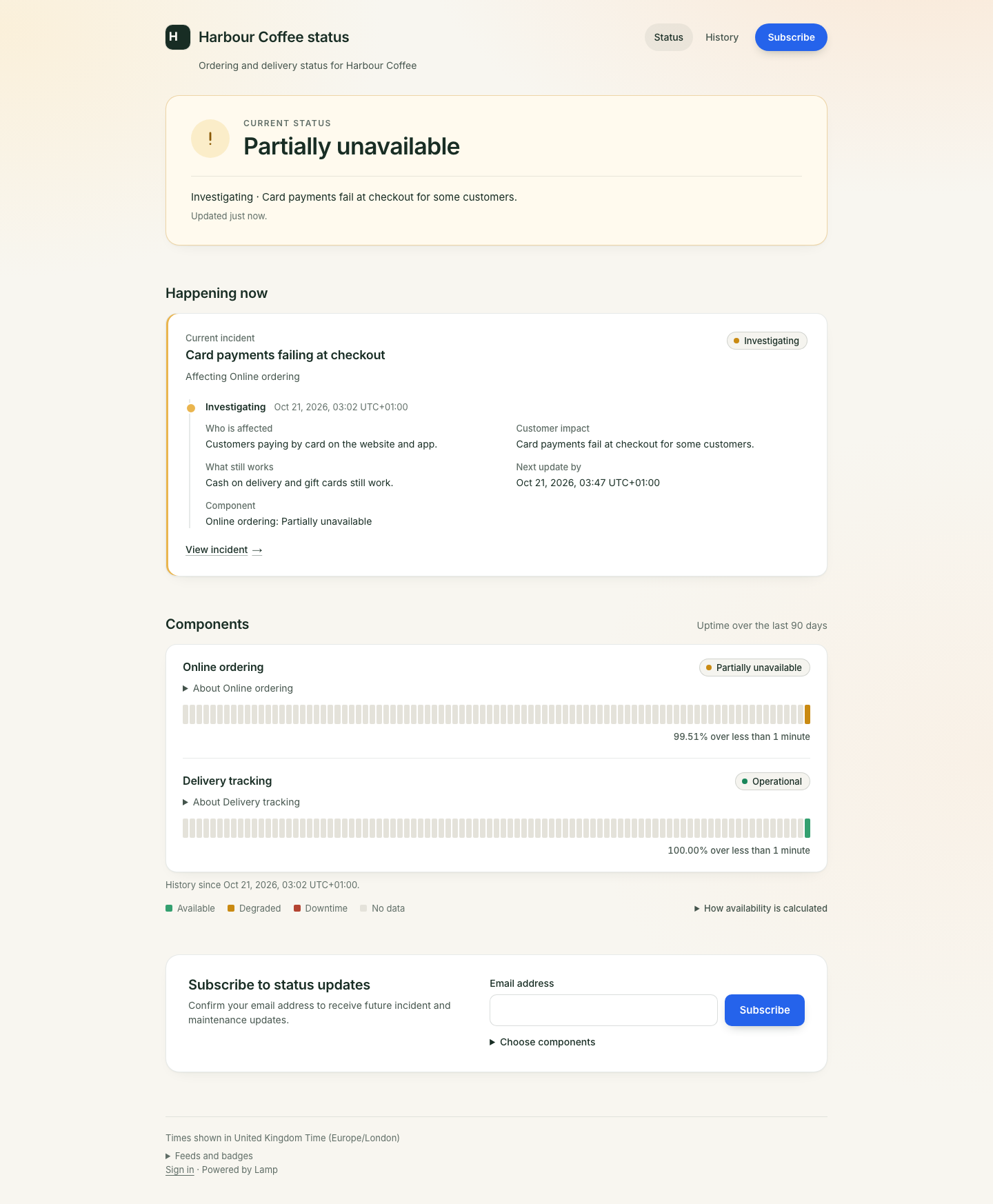
Lamp public status page at 1440 pixels, retained as the historical v1.10.0 capture and committed unchanged at the listed release revision.
Outside services
The services the project declares it sends data to, each with its reason.
owner-website-reader- SETUP-002, at the owner's request: read the supplied public website, its declared manifest and mark, and its public status page, the one it links to or one answering at status.<its domain>. An identified Statuspage, Instatus or Better Stack page's own public feeds (Statuspage /api/v2/summary.json and /api/v2/incidents.json; Instatus /summary.json, /v2/components.json and /history.atom; Better Stack /index.json and /feed) give its components, groups, page ID and past incidents; only when the owner chooses Bring its incident history too are they read once more and imported through Move in, as MOVE-002's silent history. Public DNS-over-HTTPS at cloudflare-dns.com validates every destination and redirect; private addresses are refused. No source key is used.
mail-sender- Cloudflare Workers cannot deliver email to arbitrary recipients. Subscriber notification is the product's second surface, and SUB-006 and NOTIFY-008 require authenticated bulk sending with List-Unsubscribe support. Managed hosting uses the declared Run Edit Run relay with an installation credential; ordinary hosting uses Resend, SendGrid, Mailgun, Amazon SES or Postmark directly. An explicitly configured secondary receives the same frozen envelope after five minutes of retryable primary rejections; an uncertain primary submission never switches providers.
ai-provider- DRAFT-001 only. Absent, the composer shows no suggestion control and no request is made (DRAFT-003). Internal notes are never sent (DRAFT-002).
subscriber-webhooks- SUB-009. The destinations are chosen by the buyer's subscribers, so they cannot be enumerated as named hosts at publish time; this entry is declared as a class of destinations, not one named service, which satisfies BASE-DATA-004 without a supersession because the payload carries no personal data, every request is signed, and every delivery is in the log.
team-chat-channels- NOTIFY-011 and NOTIFY-012: Slack incoming webhooks (hooks.slack.com) and Microsoft Teams channel webhooks (*.logic.azure.com, *.environment.api.powerplatform.com, *.webhook.office.com) receive the published update's public fields. The owner adds each channel; its URL is the credential and is stored encrypted.
statuspage-api- MOVE-001 only, at the owner's request: GET requests to https://api.statuspage.io with the owner's key read the page being left. The key is used for that dry run and never stored; saved API responses need no request.
betterstack-api- MOVE-001 only, at the owner's request: GET requests to https://incidents.betterstack.com/api/v2 with a Bearer API token read the chosen status page, sections, resources, reports, updates and email subscribers. Redirects and off-scope pagination are refused. The token is never stored; saved responses need no request.
run-edit-run-editor- Optional owner-enabled editor frame; separate Run Edit Run authentication and installation authority are required. Disabled by default.
identity-provider- ACCESS-002. Optional owner-linked OpenID Connect through Auth, Google, Microsoft or Okta; disabled until explicitly enabled.
external-heartbeat- Owner-selected independent heartbeat service. Disabled until configured. Cron pings only after scheduled work and database/storage/queue self-check pass.
instatus-api- MOVE-001 only, at the owner's request: fixed-origin GET requests to https://api.instatus.com read pages, selected-page components, incidents, maintenance lists/details, subscribers and audience groups. Redirects are refused. The Bearer API key is never stored; saved responses need no request.
sorry-api- MOVE-001 only, at the owner’s request: authenticated GET reads from https://api.sorryapp.com/v1/pages or keyless GET reads from the selected public Sorry HTTPS page, for the owner’s own Move in and, while Business imports are on, when Business asks through POST /api/rer/source-capture (also on Managed hosting). Redirects are refused; pagination stays on the selected collection. Keys are used only for the read and never stored. Saved responses make no network request.
pagerduty-notes- INTAKE-009: when the owner connects a sealed REST API key, each linked publication posts one note to the fixed https://api.pagerduty.com REST host. Redirects are refused. No connected key means no request.
bot-framework-keys- Slack and Teams incident commands: bounded credential-free GET requests to https://login.botframework.com/v1/.well-known/openidconfiguration and its same-origin signing keys verify Bot Framework activity tokens. Redirects are refused. No user data or token is sent.
slack-subscription-oauth- SUB-014: only a visitor-initiated Slack OAuth v2 exchange POST to https://slack.com/api/oauth.v2.access; requests only incoming-webhook. Redirects are refused. The returned webhook is encrypted and used only for the approved subscription.
operations-alerts- INTAKE-014: explicit JSM connection reads cloudId without credentials from its validated HTTPS *.atlassian.net/_edge/tenant_info. Published linked updates send notes and optional resolve-close only to fixed https://api.atlassian.com/jsm/ops/api or https://api.opsgenie.com/v2/alerts; redirects are refused.
public-metric-queries- UPTIME-008 and INTAKE-011: after an Owner or Admin connects a read-only key, query Datadog, New Relic, Pingdom or an owner-supplied public HTTPS Prometheus-compatible endpoint. Requests read aggregate values only, refuse redirects and private destinations, and never send subscriber or incident data. Query keys are sealed and excluded from archives.
sms-twilio- SUB-013 and NOTIFY-014: an owner-configured Twilio account sends opt-in, keyword replies and approved status publications. SMS stays off without provider configuration; signed callbacks record consent and delivery without tracking.
social-accounts- INTEG-002: owner-selected updates post to X at https://api.x.com, Bluesky at https://bsky.social and Mastodon at https://mastodon.social. Owner-chosen Bluesky service hosts and Mastodon instances are a destination class: public HTTPS origins only, private/internal addresses and redirects refused, with Worker global_fetch_strictly_public enforcing resolved-address safety. X uses an owner-supplied OAuth 2.0 user token with tweet.write; Bluesky uses an app password; Mastodon uses a token with write:statuses. Credentials are sealed and never returned or logged.
public-vendor-status- DEP-001. Keyless GET reads from declared public vendor status origins and explicit owner-configured public Statuspage, RSS, Atom or JSON endpoints. Public DNS checks use cloudflare-dns.com. Redirects and private addresses are refused. No subscriber or operator data leaves. Catalog origins: https://auth0.statuspage.io, https://azure.status.microsoft, https://status.anthropic.com, https://status.atlassian.com, https://status.aws.amazon.com, https://status.cloud.google.com, https://status.datadoghq.com, https://status.fastly.com, https://status.okta.com, https://status.openai.com, https://status.pagerduty.com, https://status.sendgrid.com, https://status.slack.com, https://status.stripe.com, https://status.twilio.com, https://status.zoom.us, https://www.cloudflarestatus.com, https://www.githubstatus.com, https://www.shopifystatus.com, https://www.vercel-status.com.
Scope and limits
What it will not do
- Uptime monitoring, probing, or synthetic checks: Lamp reports state that operators or accepted alerts produce, and running probes would make it a monitoring product with a second, contradictory source of truth behind the public page. For observability, see [Porthole](https://github.com/just-every/run-porthole).
- On-call scheduling, paging, and escalation: the buyer's existing alerting tool already does this, and it is the system that feeds INTAKE-001.
- More than one anonymous public status page per deployment. The existing public page keeps its address. Staff and Operators only pages use fixed paths on the operator host.
- Audience visitor sign-in, membership, subscriber settings and protected reads during database outages remain outside this release. Every active operator signed in to this Lamp can read every protected status page.
- Roles and permissions: these are one business's equal operators, and UPDATE-007 covers the one gate buyers actually ask for.
- SMS and voice notifications: per-message cost, carrier registration, and per-country consent rules that a self-hosted deployment cannot satisfy generically.
- Multi-language status pages: every incident update would need a translation before publish, which is the opposite of publishing in two minutes.
- A general-purpose operator API authenticated by API tokens: BASE-ACCESS-002 requires a session on every operator endpoint, and machine writes have one narrow door, INTAKE-001, with its own secret.
- SCIM and role synchronization: optional OpenID Connect through Auth, Google, Microsoft or Okta replaces the former SSO exclusion under ACCESS-002; provider sign-in stays off until the owner links and enables it, and magic links remain available.
- Visitor analytics and email open tracking: BASE-PUBLIC-001 keeps the page free of cookies and visitor data, and NOTIFY-004 keeps tracking pixels out of notifications, because knowing who read an outage notice is worth less than being the one page a customer can open without being counted.
- Native mobile apps: the public page is the mobile experience, and it has to work with script disabled.
Extension points
Optional conveniences for common changes. Owners can change any source, including core logic, schema and infrastructure.
page.status-rollup.v1uptime.downtime-states.v1update.review.v1incident.update-due.v1maintenance.reminders.v1subscriber.confirmation.v1notification.events.v1alert.intake.v1postmortem.due.v1incident.opened.v1incident.update.published.v1incident.resolved.v1component.status.changed.v1maintenance.scheduled.v1maintenance.started.v1maintenance.completed.v1subscriber.confirmed.v1subscriber.deactivated.v1notification.failed.v1alert.accepted.v1snapshot.published.v1status-page.header.after.v1status-page.components.after.v1status-page.incident.after.v1status-page.footer.before.v1overview.dashboard.after.v1incident.sidebar.after.v1incident.composer.fields.after.v1component.row.actions.v1subscriber.detail.after.v1settings.sections.v1mail.sender.v1ai.provider.v1
Declared limits
- Status
- Mixed evidence: limits marked estimate:true are modeled or locally measured only and still require deployment- or account-specific validation; estimate:false values are enforced configuration limits. Each entry records its evidence.
- Subscribers
- Value 1,000
- Estimate yes
- Why A local authenticated publish and native scheduled trigger persisted 1,000 unique fake-provider acceptances. The fake network used a strict 10-acceptance/second quota and 100ms acknowledgement; peak acceptance was 9/second, p95 completion was 185.474 seconds, and the last acceptance arrived in 191.362 seconds, including 64.488 seconds waiting for the trigger. This remains an estimate: it does not qualify a live provider account, quota, latency, domain configuration, or recipient delivery.
- Components
- Value 200
- Estimate yes
- Why Qualified in a populated local Worker fixture with 200 components and 25 groups. This is a representative record count; arbitrary component text and worst-case snapshot bytes remain unqualified.
- Component Groups
- Value 25
- Estimate yes
- Why Qualified alongside 200 components in a populated local Worker fixture. This is a representative group count, not a bound on arbitrary data size.
- Open Incidents
- Value 25
- Estimate yes
- Why Qualified with 25 open incidents; all 25 titles appeared on the public page. This is representative content, not a worst-case history-size limit.
- Incident Updates Per Incident
- Value 200
- Estimate yes
- Why Qualified with 200 updates on an incident; the full public timeline showed all 200 update markers. This is representative history, not a bound on arbitrary update bytes.
- Public Page Requests Per Second
- Value 10
- Estimate yes
- Why Local floor, not a hosted capacity. One Miniflare workerd process on a shared runner was driven in-process at an offered 10 requests/second with uncompressed responses and no CDN: two fresh 30-second full-page runs and two mixed-route runs each returned 300/300 HTTP 200 with no backlog (full-page p95 880.289ms and 312.709ms; mixed-route p95 138.466ms and 112.200ms). Full-page runs at 20/s fell behind on that runner; mixed routes held 20/s. A 5,000/s local attempt failed with loopback connection resets in the load client and does not bound the Worker. On Cloudflare every public read runs the Worker, which reads the R2 current pointer and serves edge-cached generation bytes; that hosted capacity is unmeasured, and no runtime rate limiter was added.
- Subscribe Requests Per Minute Per Address
- Value 5
- Estimate no
- Why Rate limit on a BASE-ACCESS-003 write path; not a capacity number.
- Intake Requests Per Minute Per Source
- Value 120
- Estimate yes
- Why A paced local run accepted 120 signed intake requests, each with HTTP 202, and durably recorded their draft incidents while the public status remained unchanged. This qualifies that fixture and path only; deployment throughput remains unvalidated.
- Upload Max Bytes
- Value 2,097,152
- Estimate no
- Why Page logos and header images; WOFF2 theme fonts have a stricter 512KB limit (BASE-INPUT-003).
- Upload Types
- Value image/png, image/jpeg, image/webp, font/woff2
- Estimate no
- Why No SVG: BASE-INPUT-002 would have to sanitise a scripting format for one logo, on the one surface that must never run anything unexpected.
- Snapshot Max Bytes Gzipped
- Value 51,200
- Estimate no
- Why PAGE-003.
- Subscription Capacity
- Value 25,000
- Estimate no
- Why SUB-020: atomic storage guards count pending and active subscriptions across all channels; deactivated and deleted subscriptions do not count. This is an admission limit; the separate subscribers entry qualifies notification delivery only.
- Webhook Subscriptions
- Value 2,500
- Estimate no
- Why SUB-020: webhook endpoint admission limit within the all-channel capacity.
- Chat Subscriptions
- Value 1,000
- Estimate no
- Why SUB-020: Slack and Teams subscriptions share this admission limit within the all-channel capacity.
Requirements
All 107 clauses of Lamp’s CONTRACT.md. They say what the project must do; the handover and verification records say what is built and tested.
DOCS 1 clause
DOCS-001Public owner documentation Requirement. Public owner guidance is available on the app host, including the selected published Markdown pages; it is separate from the status-page host. Acceptance. 1. A visitor without an operator session can read the documentation index and each selected published page on the app host. 2. A selected page renders its repository Markdown, and documentation is absent from the public status-page host.
PAGE 14 clauses
PAGE-001Contents Requirement. One initial public response contains the complete status overview, current incident information and relevant maintenance, with component uptime. Acceptance. 1. The response shows overall status and every visible component, with each current state and note. 2. Every unresolved incident shows its five most recent published updates, newest first, and a link to its complete permanent timeline. 3. Every maintenance in progress and each scheduled maintenance starting within 14 days appears. 4. Each visible component has its uptime figure and the daily record for the reporting window.PAGE-002Readable without script Requirement. The status overview and subscription remain usable without scripting, and scripting preserves the configured page time zone. Acceptance. 1. The initial HTML contains all PAGE-001 content and the subscription form of SUB-001. 2. With scripting disabled, every status, update and timestamp is readable and the subscription form submits. 3. With scripting available, the configured time zone and its label remain unchanged; operator entry, timelines, previews and public timestamps use that zone.PAGE-003Weight Requirement. The public page remains within its transfer and request budget at the component limit. Acceptance. 1. At the declared component limit, the initial HTML is at most 50 KiB gzipped. 2. Initial loading issues at most four further requests for its stylesheet, font, logo and script, all to its own origin.PAGE-004Overall status Requirement. The overall state is a single label at the top of the page, computed by the owner-replaceable rollup policy. Acceptance. 1. The supplied rollup chooses the most severe visible component state in COMP-001 order. 2. The result appears as one labeled state at the top of the page. 3. With all visible components Operational and no unresolved incident, the label is operational.PAGE-005Snapshot read path Requirement. Public page, Atom feed and widget content are published as a complete retained snapshot, and remain available while publication recovers. Acceptance. 1. Each change to PAGE-001 content produces a complete rendered public page, Atom feed and widget snapshot. 2. Serving those three surfaces reads the snapshot without any database query. 3. A failed snapshot write is retried until success; the prior snapshot continues serving during recovery.PAGE-006Serving through a failure Requirement. Public status continues to answer from retained content during primary storage, database or queue failure, with truthful stale labeling. Acceptance. 1. When the database, queue or object storage is unreachable, the page, Atom feed and widget return successful current or retained content; an origin outage can use PAGE-007’s cached response. 2. Only an installation with no snapshot ever written returns unavailable instead of status content. 3. Content not built from current data identifies its generation instant and says Last known state; a failed read never invents an operational all-clear.PAGE-007Publish latency and caching Requirement. Publications become visible promptly through every public representation, and healthy reads validate the current generation. Acceptance. 1. Stable public addresses validate the current generation when reused; unchanged content can be reused, while a newer generation makes older cached bytes ineligible for a healthy response. 2. An update, component-state change or maintenance transition reaches the page, history, incident and maintenance permanent pages, Atom feed, widget and public JSON within 10 seconds of the initiating successful request. 3. An unreachable origin can use retained content for one hour; retained last-known snapshots follow PAGE-006.PAGE-008Public read paths are not rate limited Requirement. Public status reads are exempt from per-caller rate limiting so shared customer egress stays usable during an incident. SupersedesBASE-ACCESS-003for those paths only. Public writes continue under that duty. Acceptance. 1. All public reads up to the declared per-address capacity succeed and never return a rate-limit refusal. 2. Public reads share immutable generation content; healthy reads validate the current generation without querying the database, with artifact caching reducing object-byte reads.PAGE-009Time display Requirement. Public timestamps use the configured time zone, named on the page with exact UTC offsets available in Time details. Feeds and notifications retain absolute timestamps with the configured offset. Under RL-1, the owner’s S4 exception permits a relative generation label while scripting runs. Acceptance. 1. Public page timestamps use the configured zone’s local time and name, with exact UTC offsets in Time details and ISO instants as machine-readable data. Feed and notification timestamps retain the configured UTC offset. 2. With scripting available, the generation label is relative and refreshes while the page stays open. Its tooltip gives the absolute configured-zone time, Time details gives the offset, and its machine-readable value retains the instant. 3. Initial HTML and script-disabled readers see the absolute generation time; incident, maintenance, feed and notification timestamps remain absolute.PAGE-010Atom feed Requirement. The Atom feed preserves published incident and maintenance history with permanent event identities. Acceptance. 1. The feed validates as Atom 1.0. 2. It contains one entry for every published incident update and each scheduled, rescheduled, started, completed or cancelled maintenance notice from the last 12 months, newest first. 3. Each entry identifier remains stable from first publication and is never reused.PAGE-011Embeddable widget Requirement. An embeddable banner shows overall status and an unresolved incident using the same public snapshot. Acceptance. 1. Installing one script tag renders the overall state and any unresolved incident from PAGE-005 content. 2. The widget is at most 10 KiB gzipped and loads only from the installation’s own origin.PAGE-012Branding Requirement. The owner configures branding and status artwork without changing source. Acceptance. 1. Settings control page name, logo, accent color, time zone, hostname and footer-credit visibility. 2. The footer credit is the plain text Powered by Lamp, starts enabled, and disabling it performs no network action. 3. The logo is served from the installation’s origin. 4. The favicon combines the configured logo with a mark for the current overall state; Open Graph title and image state that overall status.PAGE-013Enforced isolation Requirement. Public status has restrictive same-origin isolation and needs no CAPTCHA or consent banner. The exact header policy is documented in the public mechanisms record. The formats and configuration details are in [Public status mechanisms](docs/contract/public-details.md). Acceptance. 1. Every public response has the documented own-origin default, script, style, image, connection, form and base policies, refuses framing, prevents content-type sniffing and uses the documented referrer policy. 2. The public page contains neither a CAPTCHA nor a consent banner. 3. The public page writes no visitor data to browser storage.PAGE-014Live refresh Requirement. When scripting is available, public status refreshes in place without disturbing assistive announcements or the configured time zone. Acceptance. 1. The page polls at most every 30 seconds and replaces the overall status and newest update in place. 2. The response has a fixed field set and its size does not grow with component count. 3. With scripting disabled, no automatic refresh occurs and the generation instant is shown.
COMP 7 clauses
COMP-001States and their order Requirement. Components have one public state from a fixed vocabulary, and all severity comparisons use one order. Acceptance. 1. The only component states are Operational, Degraded performance, Partially unavailable, Major outage and Under maintenance. 2. Severity is ordered Major outage, Partially unavailable, Degraded performance, Under maintenance, Operational.COMP-002Grouping and order Requirement. Operators organize public components into ordered groups. Acceptance. 1. A component belongs to at most one group. 2. Operators set group order and order within each group, and public rendering preserves both orders.COMP-003Append-only state history Requirement. Public-state history is attributable and append-only; a correction adds a superseding fact. Acceptance. 1. Every public-state change appends previous state, new state, change instant and the causing operator or incident. 2. Prior entries are neither modified nor removed, including when UPTIME-004 corrects an interval by appending a superseding entry.COMP-004State note Requirement. A bounded plain-text note accompanies a component’s public state. Acceptance. 1. A new component note is empty by default. 2. A note of up to 250 characters appears beside that component’s state exactly as entered; a longer note is refused.COMP-005Internal components Requirement. Internal components cannot affect or leak through public status. Acceptance. 1. An internal component is absent from the page, Atom feed, widget and every uptime figure. 2. It never contributes to overall status.COMP-006Component state is claimed, not set Requirement. Incidents, maintenance and operator standing claims independently contribute to the component’s public state. Acceptance. 1. An unresolved incident, in-progress maintenance or operator standing claim can claim a state; incident and maintenance attachment chooses a state per component. 2. The most severe active claim sets public state, and no active claim means Operational. 3. Resolving an incident, completing maintenance, attaching or detaching a component and setting or clearing a standing claim each recompute public state within ten seconds.COMP-007Deletion Requirement. Deleting a component removes its public state history and uptime while published communication retains its name. Acceptance. 1. The component, its state history and every associated uptime figure disappear from the public page within ten seconds. 2. Published incident and maintenance updates keep the deleted component’s name.
UPTIME 6 clauses
UPTIME-001Definition Requirement. The public uptime figure derives from component-state history over the trailing ninety days. Acceptance. 1. Each visible component shows the percentage of the ninety-day window not in a downtime state, using one-minute resolution. 2. The figure rounds down to two decimals so any downtime prevents a displayed 100.00%.UPTIME-002Downtime weights Requirement. The owner-replaceable downtime policy weights affected minutes consistently with the displayed incident history. Acceptance. 1. The supplied weights count Major outage and Partially unavailable as one downtime minute per minute, Degraded performance as one half, and Under maintenance as zero.UPTIME-003Short history Requirement. Uptime begins only where state evidence exists and labels short coverage honestly. Under RL-2, short coverage does not invent a whole day. Acceptance. 1. If recorded history begins after the reporting-window start, uptime is computed from that first record. 2. Coverage under one day is labeled in elapsed hours and minutes, with less than 1 minute below a minute; from one day it uses whole days. 3. A component with no data says No data.UPTIME-004Corrections Requirement. An operator corrects a closed history interval with an attributable reason while retaining original facts. Acceptance. 1. The operator supplies corrected state, closed interval and reason; omitting the reason is refused. 2. Correction appends a superseding history fact rather than changing the original. 3. Every affected uptime figure is recomputed within sixty seconds. 4. The audit records operator, interval and reason.UPTIME-005Stated method Requirement. The initial public page explains uptime weights and window beside its figures; every published incident contributes through its component claims. Acceptance. 1. Initial HTML names the selected weight of each state and the reporting-window length. 2. No published incident is invisible to uptime: publishing requires at least one claimed component.UPTIME-006Daily record Requirement. The page displays each visible component’s daily record without inventing coverage before history begins. Acceptance. 1. One daily mark covers each day of the reporting window for every visible component. 2. Any downtime day labels its weighted downtime minutes. 3. Days before tracking begins are labeled No data and visually distinct from a zero-downtime day.
INCIDENT 10 clauses
INCIDENT-001Lifecycle Requirement. An incident follows one public lifecycle. Acceptance. 1. An incident has exactly one state: Investigating, Identified, Monitoring or Resolved. 2. A new incident starts in Investigating. 3. Only publishing an update changes the incident to the lifecycle that update selects.INCIDENT-002Impact Requirement. An incident retains the greatest component impact it has reached. Acceptance. 1. Derived impact is the most severe state claimed on any attached component since opening. 2. Resolution retains that peak impact. 3. Without attached components the incident has no impact and cannot be published; UPDATE-001 governs the required attachment.INCIDENT-003Reference Requirement. Every incident retains a permanent unique public reference. Acceptance. 1. Each incident has an INC- reference followed by digits and a permanent public address containing it. 2. New manual and alert-intake incidents share one durable increasing sequence. 3. Existing references and public addresses remain unchanged. 4. Deletion, restart and failed creation never permit reference reuse; a failed creation may leave a gap. 5. Legacy timestamp-sized references do not choose the sequence’s starting point.INCIDENT-004Published updates are immutable Requirement. Corrections add to the public record without changing earlier wording. Acceptance. 1. Published updates cannot be edited or deleted. 2. A correction is a new publication identifying the update it corrects. 3. Original and correction remain on the public timeline in publication order.INCIDENT-005Reopening Requirement. An erroneous resolution can be corrected without losing its history. Acceptance. 1. Publishing Investigating reopens a resolved incident. 2. Resolution and reopening both remain on its public timeline.INCIDENT-006Overdue update Requirement. Operators distinguish a missed commitment from public incident wording. Acceptance. 1. When the latest published next-update time passes without newer publication, the operator app marks the incident overdue. 2. The public page retains the committed time and contains no overdue label.INCIDENT-007Deletion Requirement. An incident can be removed from public history with a recorded reason. Acceptance. 1. Deletion requires a reason and omitting it is refused. 2. The public page, history page and Atom feed remove the incident within ten seconds. 3. The deletion record identifies its operator, reason and time.INCIDENT-008Internal notes Requirement. Incident notes remain operator-only context. Acceptance. 1. A signed-in operator can read internal incident notes. 2. Public page, Atom feed, widget, notifications and AI requests omit those notes.INCIDENT-009Retroactive incidents Requirement. Operators record past incidents without replaying subscriber notifications. Acceptance. 1. An operator opens incidents with historical update publication times. 2. Public timeline and history show those original times. 3. Component claims enter state history at those times and contribute to UPTIME-001. 4. No update of the retroactive incident notifies subscribers, including later current-time updates.INCIDENT-010Update due Requirement. Reminder timing follows the published commitment. Acceptance. 1. Unless the owner replaces the lead policy, an update becomes due ten minutes before its commitment. 2. Until newer publication or resolution, Overview and the incident list show its due time and an action opens its composer and brief. 3. Each commitment sends one due email and, after its time passes, one overdue email. 4. The scheduled trigger sends both without an open operator page. 5. Resolved incidents, newer publications and retroactive updates send neither. 6. A commitment already past when this behavior is introduced sends no reminder email. 7. The public page shows the committed time without due or overdue labels.
UPDATE 9 clauses
UPDATE-001Template Requirement. Updates describe customer impact and the next communication commitment in bounded plain-text fields. Acceptance. 1. Publishing requires an attached component, affected-audience and customer-impact statements of at most 250 characters each, and a next-update time unless Resolved. 2. Resolved updates need no next-update time and show no next-update promise on any surface, including older stored resolved updates retaining a time. 3. Optional what-still-works and details statements accept at most 250 and 500 characters respectively. 4. Fields are plain text with no HTML or Markdown interpretation apart from UPDATE-013’s bare HTTPS links. 5. Omitting required fields, exceeding lengths or attaching no component refuses publication without changing state. 6. The next-update time is a commitment to communicate, never a resolution-time estimate.UPDATE-002One rendering Requirement. Wording stays consistent across public and delivery surfaces. Acceptance. 1. Page, Atom feed, widget and email retain every populated update field. 2. Each surface omits fields the update does not carry.UPDATE-003Sets the lifecycle Requirement. Publication changes lifecycle and releases resolved claims together. Acceptance. 1. Every publication sets the selected lifecycle. 2. Resolved publication records the incident end time. 3. Resolved publication recomputes every attached component under COMP-006.UPDATE-004Preview Requirement. Before publication the composer previews the customer-facing update. Acceptance. 1. The composer shows the update as the public page renders it. 2. The composer shows the update as the notification email renders it.UPDATE-005Drafts Requirement. Private drafts survive reload without reviving obsolete publication wording. Acceptance. 1. An unpublished update appears on no public surface. 2. The last edit saves within two seconds and reload restores it unchanged. 3. Publication consumes the draft and starts an empty next-update draft with lifecycle prompts. 4. A stale tab cannot resurrect published wording or overwrite a newer acknowledged draft. 5. Draft writes, template application, scheduling and publication require the acknowledged draft version. 6. A fresh empty composer claims no save before native acknowledgement, and Publish needs a complete acknowledged draft. 7. Lost-acknowledgement reconciliation identifies the attempted write and preserves later workflow changes.UPDATE-006Scheduled publish Requirement. A scheduled update stays private until its committed publication time. Acceptance. 1. A future-dated update publishes within 240 seconds after its time. 2. Before its time no public surface or notification carries it. 3. Under the owner’s review policy, an unreviewed due update stays a draft and raises a NOTIFY-006 operator notice.UPDATE-007Review Requirement. The owner chooses whether a second operator reviews updates. Acceptance. 1. Under required review, an author’s unreviewed update is refused until a different operator reviews it. 2. The update records reviewer and review time. 3. When review is not required the review policy does not hold publication.UPDATE-008Atomic publication and recipients Requirement. Publication commits its fixed recipient set before dispatching without holding publish. Its committed success starts PAGE-007’s visibility bound and NOTIFY-002’s delivery bound. Acceptance. 1. The selected channels’ recipients and the update commit together before success is returned. 2. Narrowing selection afterwards preserves committed delivery; unsubscribing suppresses it under SUB-008. 3. Failed publication exposes no update and records no recipients. 4. Dispatch retries the committed set until success without blocking publication.UPDATE-009Templates Requirement. Operators save and apply reusable wording and component choices. Acceptance. 1. A template retains UPDATE-001 fields, attached components with their claimed states, and lifecycle. 2. Applying it fills the composer and stages those choices without publishing.
MAINT 6 clauses
MAINT-001Distinct from incidents Requirement. Maintenance has a window, components and its own durable reference. Acceptance. 1. Maintenance records start, end and attached components and appears separately wherever incidents and maintenance share a surface. 2. Its SCH- reference has digits and new references increase independently of incidents and legacy timestamps. 3. Existing references remain unchanged; deletion, restart and failed creation never allow reuse, although failures may leave gaps.MAINT-002Automatic transitions Requirement. Automatic maintenance follows its declared window. Acceptance. 1. Scheduled moves to In progress within 240 seconds after start without an operator action. 2. In progress moves to Completed within 240 seconds after end without an operator action.MAINT-003Component states Requirement. Maintenance temporarily contributes claims without discarding others. Acceptance. 1. In progress maintenance claims Under maintenance on every attached component. 2. It contributes no claim before starting or after completion. 3. COMP-006 applies throughout, retaining preexisting operator and incident claims after the window.MAINT-004Overrun Requirement. An overrun stays public until completion or extension. Acceptance. 1. Fifteen minutes after its end, an In progress maintenance shows Running longer than planned beside its original end on the public page. 2. The indication remains until an operator completes it or extends the window. 3. Extension preserves start, changes end and removes the overrun indication.MAINT-005Reminders Requirement. The owner may replace maintenance notice timing. Acceptance. 1. Unless the owner replaces the reminder policy, subscribers are notified at scheduling, twenty-four hours before start, at In progress and at Completed.MAINT-006Rescheduling and cancellation Requirement. Changed and cancelled maintenance tells its already-notified audience. Acceptance. 1. A changed window notifies every subscriber already notified about the maintenance. 2. Cancellation publishes a cancellation notice to those same subscribers. 3. Cancellation removes the upcoming listing within ten seconds and retains the cancelled maintenance in history.
SUB 12 clauses
SUB-001Subscribing Requirement. Visitors subscribe their own email address through the public page and receive confirmation before incident communication begins. Acceptance. 1. Submitting an email address creates a pending subscription and sends one confirmation to that address within 60 seconds. 2. Repeated submissions give that address at most one confirmation in any 24 hours. 3. Unsubscribing with an emailed link restores the confirmation allowance, so a new subscription sends a fresh confirmation. 4. A pending subscription receives no notification other than its confirmation. 5. The form works with scripting disabled, refuses a cross-site submission and needs no ambient session or form token.SUB-002Confirmation Requirement. Under the subscriber confirmation policy, only following the emailed confirmation link activates the subscription. Acceptance. 1. A submitted subscription remains pending until its confirmation link is followed. 2. Following the confirmation link makes that subscription active.SUB-003Pending expiry Requirement. Unverified pending addresses are retained only while confirmation remains possible. SupersedesBASE-DATA-002for pending subscriptions because the submitting visitor may not own the address. Acceptance. 1. An unconfirmed pending subscription and its address are deleted after 72 hours.SUB-004Component selection Requirement. Subscribers choose the components whose incident and maintenance communication they receive. Acceptance. 1. The subscription form and management page preserve exactly the components ticked; no selection follows all visible components. 2. An incident or maintenance notifies a subscriber only when it claims a state for a selected component. 3. An unnarrowed subscription follows visible components added later, while a narrowed selection remains unchanged. 4. Attaching a component to an unresolved incident sends one latest-update catch-up to each eligible subscriber who has never received that incident; subsequent updates then arrive normally.SUB-005Cookieless subscriber tokens Requirement. Emailed subscriber links carry opaque authority for one subscription, never a general login. Token pages allow token transmission on arrival required by one-click unsubscribe; this supersedesBASE-PUBLIC-001only for those token-addressed paths. The technical profile is specified in [Delivery details](docs/contract/delivery-details.md). Acceptance. 1. A public subscriber token addresses one subscription, has at least 128 bits of entropy and grants no unrelated capability. 2. Deactivation or deletion revokes that subscription's tokens. 3. Token-page responses suppress referrers and indexing.SUB-006One-click unsubscribe Requirement. Every notification offers standards-compatible one-click unsubscribe. Its public rate allowance belongs to the subscriber token, so one mailbox provider cannot exhaust another subscriber's allowance. The technical profile is specified in [Delivery details](docs/contract/delivery-details.md). Acceptance. 1. Notification email contains the mail and web unsubscribe values, the one-click declaration and a visible unsubscribe link. 2. Both supported form encodings deactivate that subscription with a successful empty response, no redirect and no further interaction. 3. The message signature covers both unsubscribe headers. 4. One token's rate allowance never consumes another token's allowance, including requests from one mailbox provider.SUB-007Managing a subscription Requirement. The emailed management link lets a subscriber manage its own channel and component selection without an operator session. Acceptance. 1. Opening the management link shows the subscription channel and saved component selection. 2. The subscriber can change its component selection and unsubscribe there without a session.SUB-008Unsubscribe integrity Requirement. Opt-out takes effect for queued communication as well as future publications. Acceptance. 1. A deactivated subscription receives no later notification. 2. A notification committed before deactivation but dispatched afterwards sends nothing and records suppression.SUB-009Webhook subscribers Requirement. A webhook destination and contact address receive complete, authenticated published events. The contact address exists for destination-deactivation notices. Slack incoming-webhook destinations receive Slack's message form; all others receive Lamp's form. The technical profile is specified in [Delivery details](docs/contract/delivery-details.md). Acceptance. 1. A destination and contact address create one webhook subscription. 2. Current and retiring signing secrets each verify the same complete event, allowing rotation without a gap. 3. The body includes the incident, every published update and every attached component's previous and new state, without a subscriber address. 4. Only a successful receiver response within 30 seconds counts as delivery; redirects fail. 5. Slack text keeps each bare secure-web URL bracketed with punctuation outside, never a labelled link; rich-text link labels are their URLs and each field reassembles unchanged. 6. Lamp-form update fields equal the published text byte for byte.SUB-010Failing destinations Requirement. Destinations with permanent or repeated delivery failures deactivate with a recorded reason and receive no later notification. Acceptance. 1. One hard bounce deactivates the address and records the hard-bounce reason. 2. One spam complaint deactivates the address and records that reason. 3. Five consecutive soft-bounced notifications deactivate the address with that reason. 4. Ten consecutive failed webhook deliveries deactivate the endpoint with that reason and email its contact. 5. A deactivated destination receives no further notification.SUB-011Operator view Requirement. Operators inspect all subscribers, their consent state and selected components, including deactivation facts. Acceptance. 1. Every subscriber is reachable, including records beyond the first page. 2. The view shows channel, pending/active/deactivated state, component selection, and deactivation reason and time. 3. Deleting a subscriber erases its email address or endpoint.SUB-012No enumeration Requirement. The public subscription form does not disclose whether an address is already subscribed. Acceptance. 1. Existing and new addresses receive identical status and body without creating another subscription. 2. An existing address gets one management-only email and no extra message content.
NOTIFY 12 clauses
NOTIFY-001What notifies subscribers Requirement. The notification-event policy covers incident and maintenance communication, with NOTIFY-017 adding opted-in component changes. Acceptance. 1. An incident notifies on its first published update, each later update and resolution. 2. Scheduled maintenance notifies according to MAINT-005. 3. A component change outside incident or maintenance notifies nobody unless the subscriber opted into NOTIFY-017.NOTIFY-002Delivery time Requirement. At the installation's stated subscriber capacity, every eligible update email reaches provider acceptance within five minutes after successful publication. Acceptance. 1. A complete capacity-sized recipient set is accepted within five minutes of successful publication.NOTIFY-003Retry Requirement. A retryable notification failure gets five retries with exponential backoff over one hour, then a terminal failure against subscriber and update. Acceptance. 1. A retryable failure produces five retries after the first attempt. 2. The retry schedule backs off exponentially across one hour. 3. Exhaustion records failure against the affected subscriber and update.NOTIFY-004Delivery log, without tracking Requirement. The notification log exposes delivery facts for each recipient and supports channel, outcome and update filtering plus CSV. It adds subscription-communication fields to the Base mail-outcome duty. Acceptance. 1. Each notification records subscriber, channel, update, queue time, outcome and outcome time. 2. Outcomes distinguish queued, delivered, bounced, complained, suppressed and failed. 3. Messages contain no tracking pixel or tracked link. 4. Each channel, outcome and update filter returns matching rows, and the complete CSV matches those filters.NOTIFY-005At most once Requirement. Each published update has at most one notification to a subscriber on each selected channel. Acceptance. 1. Retrying publication or redelivering the queue job never sends that subscriber the update twice on one channel.NOTIFY-006Operator alerts Requirement. Operators receive one email per communication obligation or terminal delivery event. Acceptance. 1. Each next-update-due event sends at most one email. 2. Each overdue incident sends at most one email. 3. Maintenance overrun, a scheduled update held for review, and an alert-created draft incident each send at most one operator email. 4. Terminal notification failure sends at most one operator email.NOTIFY-007Channels are per update Requirement. Operators choose subscriber channels independently for each update while every public surface receives it. Acceptance. 1. The selected subscriber channels, including an empty selection, determine the committed recipient set and remain in the delivery log. 2. The public page, Atom feed and widget always receive the update and cannot be deselected.NOTIFY-008Who the deployment emails Requirement. Installation email reaches only operators, pending subscriber confirmations or active subscribers, using the configured sender through the supported mail-sender extension. Acceptance. 1. Only an operator, a pending address for its single confirmation or an active subscriber can receive email. 2. Every notification uses the configured From address through the mail-sender extension.NOTIFY-010Mail headers Requirement. Notification email identifies the page, avoids automatic replies and threads incident updates. Setup and deployment require reachable DKIM and DMARC records for the configured sender; aligned DKIM suffices without SPF on the From domain. The technical profile is specified in [Delivery details](docs/contract/delivery-details.md). Acceptance. 1. List identity, archive and help headers identify the page; the automatic-message declaration avoids vacation replies. 2. Every update after the first names the first email in both threading headers. 3. Setup and deployment refuse a missing reachable configured DKIM key or DMARC policy and name the missing record. 4. Aligned DKIM is accepted without SPF on the From domain.NOTIFY-009Delivery never blocks publication Requirement. Delivery failure never withholds a committed public update; its notification set resumes when the failed channel recovers. Acceptance. 1. Publication succeeds despite a failing mail provider, queue or subscriber endpoint. 2. The public page, feed and widget meet PAGE-007 despite the failure. 3. Recovery delivers the original committed notification set under NOTIFY-003.NOTIFY-011Slack and Teams channels Requirement. Operators connect Slack and Microsoft Teams publication channels, selecting components; no selection follows all visible components. The technical profile is specified in [Delivery details](docs/contract/delivery-details.md). Acceptance. 1. A Slack or Teams destination is saved with its component selection. 2. The destination URL is stored encrypted and never returned or shown again after saving. 3. Only each provider's documented webhook hosts are accepted.NOTIFY-012Channel posts Requirement. Selected Slack and Teams channels receive one publication for the affected visible components, committed with the incident update. Acceptance. 1. Publishing with chat selected atomically commits one post per following channel. 2. A publication retry or repeated delivery pass never posts twice. 3. A retroactive update posts to no channel.
INTAKE 7 clauses
INTAKE-001Authenticated requests Requirement. A monitoring source accepts only requests authenticated by its configured signing secret or bearer token. Signed requests authenticate the received bytes before parsing. Datadog, Pingdom and Uptime Kuma can use the bearer alternative. Acceptance. 1. Only a valid HMAC-SHA256 over the timestamp and exact received body, with a timestamp within five minutes of the installation clock, is admitted for a signing-secret source. 2. Only the configured bearer token is admitted for a bearer source. 3. An absent, malformed, stale or non-matching credential returns 401 and creates no record.INTAKE-002Alerts never publish Requirement. The source-specific intake policy controls accepted alerts. Under the held intake policy an alert remains a private draft until publication; AUTO-001 carries component-specific alternatives. An agent publication carries external and live classes decided by company policy. Acceptance. 1. Under the held intake policy an accepted alert creates or updates a draft within 30 seconds. 2. That intake changes no public page, feed, widget or other public surface. 3. Publication follows UPDATE-008 and supplies every UPDATE-001 narrative field; an alert payload alone is not a completed narrative.INTAKE-003Deduplication Requirement. Unresolved alert keys and redelivered requests retain one incident and one set of alert work. Acceptance. 1. Distinct deliveries with the same key attach to the same unresolved incident instead of creating another. 2. Redelivery of an accepted request returns its original status and adds no incident, draft or alert record.INTAKE-004Recovery alerts Requirement. A recovery alert adds evidence against its matching alert without publishing a resolution. Acceptance. 1. A recovered event records its recovery time against the matching alert key. 2. Recovery changes no public surface and no incident lifecycle state.INTAKE-005Payload mapping Requirement. A generic source maps its own payload fields to its alert key, title and firing/recovered state, with rejected mapping reasons visible against the source. Acceptance. 1. Saving source-specific JSON paths makes key, title and state interpretation follow those fields. 2. A payload missing its configured deduplication-key path returns 400 and is recorded against the source with an operator-visible reason.INTAKE-006Monitor presets Requirement. Datadog, UptimeRobot, Better Stack and Pingdom presets accept their documented alert payloads and map each source to one component. Providers can use the bearer header or token-address form when unable to send a header. Acceptance. 1. Each documented firing payload creates or updates a private draft attached to its mapped component. 2. The generated credential is shown once and omitted from subsequent listings. 3. Missing or wrong credentials return 401 and record nothing. 4. Another provider’s payload returns 400 and is recorded as invalid against the source. 5. Firing alerts have no published update and change no public surface.INTAKE-007Preset recovery Requirement. Preset recovery closes only unpublished drafts. Published incidents retain their lifecycle and receive evidence under INTAKE-004. Acceptance. 1. Each preset’s recovery resolves its matching never-published draft without publishing any update or public trace. 2. A published incident retains its lifecycle and records the recovery evidence.
DRAFT 4 clauses
DRAFT-001Suggested update Requirement. A configured model supplies editable update suggestions from DRAFT-004’s brief. Suggestion generation is standard work; any agent publication or next-update commitment carries its computed external, live or commitment classes under company policy. Acceptance. 1. Requesting a suggestion fills only nonempty suggested text fields, leaves empty results as previously written, and every field remains editable. 2. Each filled field cites only known brief references; an open question or unknown reference is removed and unsourced text is marked assistant-written with no source. 3. Each field’s sources appear beside it and open the corresponding brief item. 4. The suggestion proposes neither lifecycle nor next-update time. 5. Generation leaves saved incident, public page, feed and widget unchanged and unpublished.DRAFT-002Inputs Requirement. Suggestion requests use the same visible incident brief as the operator: accepted alerts, published updates, attached public components and their claims, plus configured tone instructions. Acceptance. 1. The provider receives the DRAFT-004 brief unchanged. 2. Internal notes and internal components are absent from the provider request even when present on the incident. 3. Configured tone instructions are included with the request.DRAFT-004Incident brief Requirement. The incident page, including alert-created drafts, shows a model-free brief of facts and computed open questions. A collapsed view shows exactly what the suggestion would send. Acceptance. 1. Known facts list every accepted alert with time and source, every published update and every attached public component with its claimed state. 2. Questions identify no attached component, missing audience or customer-impact wording, an unresolved draft without next-update time, and an alert-raised draft never published. 3. Questions also identify monitor recovery while the latest published lifecycle is unresolved, and a passed commitment without a newer update. 4. Every fact and question has a stable reference. 5. The brief is built without a model from the DRAFT-002 inputs alone. 6. The operator page’s collapsed view equals the suggestion input.DRAFT-003Absent or failing provider Requirement. AI provider failure remains separate from normal publication. Adapter details are in [intake details](docs/contract/intake-details.md). Acceptance. 1. Without a configured provider, no suggestion control appears and no AI request is made. 2. A provider failure or lack of response within 20 seconds produces a visible composer error. 3. All other publication paths remain usable after provider failure or timeout.
TEAM 4 clauses
TEAM-001Equal operators Requirement. Every operator has one role and server-enforced access under TEAM-004. Review under UPDATE-007 applies in addition to publish permissions. Acceptance. 1. Every active operator has the product privileges assigned to their TEAM-004 role. 2. Incident, maintenance, component and subscriber operations enforce that role on the server. 3. UPDATE-007 review remains additional to role-based publish permissions.TEAM-002Management Requirement. Settings manages operator invitations and removal. The operator established during setup retains the self-removal protection. Acceptance. 1. A Settings invitation admits the invited operator into Lamp. 2. Settings can remove an operator. 3. Only the setup operator can remove their own protected setup identity.TEAM-003Attribution Requirement. Lamp’s publication, state, maintenance, correction and subscriber-deletion records expose the acting operator privately. Acceptance. 1. A published update, component state change, maintenance change, history correction and subscriber deletion each records the operator who acted. 2. The acting operator’s name appears in the operator app and no public surface.TEAM-004Roles Requirement. Lamp defines Owner/Admin, Communicator, Responder and Viewer product privileges and keeps its last Owner recoverable. This replaces TEAM-001’s common owner role; review under UPDATE-007 remains additional. Acceptance. 1. Owners and Admins manage settings, team, integrations, pages and billing-relevant providers; Communicators publish, resolve, schedule maintenance and manage subscribers. 2. Responders draft, write internal notes and attach components without publish rights; Viewers only read, including private pages. 3. A Responder’s publish is refused while a Communicator publishes that same draft, and a Viewer cannot change Settings. 4. The setup operator is an Owner and the last Owner cannot be demoted or removed. 5. Every role refusal has an audit record naming operator, requested action and time; role changes appear in the audit view with actor and time. 6. Only Owners and Admins can read the audit log; a Communicator is refused.
HIST 4 clauses
HIST-001Public history Requirement. Public history lists resolved incidents and completed maintenance for the last twelve months, grouped by month. Acceptance. 1. Both kinds of completed record appear in their month and older records stay outside the twelve-month index. 2. Each record shows its start, end, duration, affected components and every published update.HIST-002Post-incident report Requirement. An operator attaches one report to a resolved incident with summary, timeline, cause and remediation, then publishes it to customers. Acceptance. 1. The one report retains all four saved fields on that resolved incident. 2. Publication appears on its public incident page within ten seconds. 3. Subscribers are notified only on the channels selected for the report, using NOTIFY-007’s channel selection.HIST-003Report due Requirement. A sufficiently severe resolved incident without a report becomes visibly report-due under the replaceable report-due policy. Acceptance. 1. Seven days after an incident that claimed Partially unavailable or Major outage resolves without a report, the operator app marks it as owing a report.HIST-004Export contents Requirement. Lamp’s export carries the complete status-page record graph and original uploaded images; Base supplies restore and equivalent re-export duties. Acceptance. 1. The JSON includes every incident and update, component and its state history, maintenance and notices, subscriber channel/state, delivery record and post-incident report. 2. The JSON includes every setting and audit entry. 3. Every uploaded image is retained as its original bytes.
SETUP 2 clauses
SETUP-001Setup readiness Requirement. Setup asks the owner nothing Lamp can do itself. Overview reports the real public page and subscription checks, with an address-specific explanation and action when a check fails. Acceptance. 1. Every change republishes the public page; Lamp checks that rendered page and its real subscription form after publication and on each minute check. 2. Changing the hosted sender checks its provider authentication, and the check repeats daily. 3. Overview shows the public address, publication time and page/form check times; Review page opens the preview and its checks, and Change address opens Settings. 4. A failed check makes the line amber with a short reason and one action, and results remain attached to the address actually checked. 5. The deployment address is the public address unless the owner chooses an optional custom domain. 6. Local development suppresses outgoing mail, has no captured-mail inbox and gives the owner one-click entry without email. 7. Publishing to an active subscriber locally records a suppressed delivery visible in Notifications without representing it as provider acceptance. 8. The local sender reads as email off, and public reading remains database-free.SETUP-002First-run setup Requirement. First-run setup begins with the owner's website and lets them edit what the site supplied before confirming the installed page. The original setup decisions are recorded in RULINGS.md. Acceptance. 1. Every operator document sends a signed-in owner with no saved first-run completion to setup; a signed-out setup visitor signs in and returns there. 2. Lamp reads the public website once without running scripts, refusing private and loopback addresses at every redirect, and fills only observed page name, tagline, PNG mark, accent and navigation components. First-run setup and website confirmation preserve any valid saved time zone; only an invalid saved zone adopts a valid browser time zone, or UTC when neither zone is valid. 3. A linked Statuspage, Instatus or Better Stack page, or the site's status subdomain, supplies its own components and groups instead of navigation guesses, labeled with their source. 4. Bring its incident history too starts unselected; when selected it imports only resolved incidents and their updates at original times, silently through Move in, without active incidents, maintenance or subscribers. 5. A status feed with no components changes none; an unreadable site or omitted website leaves editable plain defaults with one calm explanation. 6. Confirming stores the edited settings, PNG mark and components and durably marks setup complete; all remain editable in Settings. 7. After completion setup opens the app; migration marks installations with a pre-existing operator complete, and rerunning setup never clears that completion.
ACCESS 2 clauses
ACCESS-001Owner-terminal sign-in Requirement. An owner with installation database authority can issue a one-use terminal sign-in link for an existing active operator without creating another account. Command details are documented in [terminal access](docs/contract/operations-details.md). Acceptance. 1. Issuing a terminal link requires the installation's session secret from the command environment and refuses a missing secret by name. 2. The issued link uses the native hashed twenty-minute single-use flow, prints its raw value exactly once and records sign-in link created from the command line. 3. Issuance creates neither an operator nor a session; consuming the link creates the Base session. 4. Unknown, deactivated and erased operators receive the same refusal.ACCESS-002Optional identity-provider sign-in Requirement. The installation can add optional OpenID Connect sign-in through Auth, Google, Microsoft or Okta while keeping email magic links available. This replaces the earlier SSO exclusion; SCIM and role synchronization are separate target work. Acceptance. 1. The optional provider is unused until the owner links it and enables sign-in. 2. Auth, Google, Microsoft and Okta sign-in can be linked while native email access remains usable.
MOVE 7 clauses
MOVE-001Dry run first Requirement. Move in previews a switch from Statuspage, Better Stack, Instatus or Sorry before writing Lamp records, and applies only the exact source and page state the owner reviewed. Acceptance. 1. The owner can supply a source API key and page identity or saved responses; source credentials are read once from the source's fixed origin and never stored. 2. The dry run counts every component, group, incident and its updates, maintenance window, subscriber and exposed notice or update template as imported, changed, skipped or refused, with reasons, and writes no record. For Sorry, the dry run and saved job also account for every supplied field path as mapped, changed, raw-only, deleted or refused, with a reason and next action; unknown nested fields, shortened text and unsupported resource files cannot be silently ignored. 3. Changing either the source or Lamp page after review refuses application and requires a fresh dry run. 4. A dry run names each excess subscriber over a SUB-020 channel capacity and refuses excess rows; an over-limit apply writes nothing until a narrowed review fits.MOVE-002Retroactive and silent Requirement. Imported incident and maintenance history is silent and preserves its original timing rather than replaying publication. Acceptance. 1. Each incident update keeps its original publication time, and imported component state history derives from those times under INCIDENT-009. 2. Past maintenance is completed; import creates no lifecycle maintenance notice and queues no incident or maintenance notification. 3. Preview, apply, resume, job reads and Cutover checks send no mail. 4. Imported email subscribers remain pending for the separate invitation action.MOVE-013Explicit imported invitations Requirement. The owner explicitly invites eligible imported email subscribers, without replaying past incidents or extending their original confirmation deadline. Acceptance. 1. Only the signed-in owner's explicit invitation action sends a confirmation, with no past incident content. 2. Repeated or concurrent invitation batches hand each eligible address to transport at most once. 3. Statuspage, Better Stack and Instatus invitations expire seventy-two hours from import review even when sending is delayed; expired subscribers cannot be invited and SUB-003 removes unconfirmed addresses. 4. A proven failure before submission can be retried; an interrupted or uncertain submitted attempt remains claimed and is not automatically resubmitted.MOVE-003One import per source Requirement. Repeating an imported source never imports its already-owned records again, including across source imports. Acceptance. 1. Repeating the same source reports already imported, preserves record counts and public aliases, and creates no notification work. 2. A record already imported is not imported again from another source.MOVE-004Undo Requirement. Undo removes unchanged imported records, retains edits and their dependencies, and explains each retained record without sending notifications. Acceptance. 1. Undo removes every unchanged record created by the import. 2. A record an operator or subscriber changed, and every record it still needs, survives undo with a named explanation. 3. Undo sends no notification.MOVE-005Old public addresses Requirement. The moved public hostname keeps safe imported incident, maintenance and feed addresses working from the same public snapshot. Source-specific address rules are documented in [import continuity](docs/contract/operations-details.md). Acceptance. 1. An imported incident, maintenance or supplied shortlink permanently redirects on the public host to that surviving Lamp record; maintenance has a permanent page. 2. Sorry numeric and supplied notice paths reach the corresponding record, and its notice/history/month listings redirect to Lamp history while the import remains. 3. Statuspage and Instatus history Atom addresses and Better Stack's source Atom address serve Lamp's feed, including an import with no incident history, until complete undo removes the import. 4. Redirects and feeds use the page's versioned snapshot with no database query; reapply creates no duplicate alias, and conditional undo removes only aliases for removed records. 5. Unsafe addresses, native-route collisions and conflicting destinations are named and refused on new imports; a retained old source names unusable aliases without withholding the snapshot. 6. Missing shortlinks are not invented, source-owned shortlink hosts remain outside Lamp control, and Better Stack report paths remain unavailable unless an unchanged saved source webhook supplies an exact matching shortlink. 7. Better Stack maintenance messages remain historical updates and create no native lifecycle notice or replayed notification.MOVE-006Cutover preview Requirement. Cutover previews old-to-new addresses and reader limits before and after import, and checks the public addresses the owner selected without claiming DNS or inbox proof. Acceptance. 1. The dry run and saved import show up to twenty-five old incident/maintenance addresses, proposed or surviving permalinks, unavailable addresses and source-host limits. 2. The preview lists source feeds, unsupported JSON/RSS/widget readers and eligible invitations with their original expiry deadline. 3. An Opens check follows redirects without credentials and verifies both the final native address and successful HTML; failures remain visible. 4. The ordered guide covers import, preview, explicit invitations, hostnames/custom domains, rechecking and retaining the source through the confirmation window.
Baseline
Selected ownership clauses from the 45 in the project’s BASELINE.md. They are declared requirements; evidence is recorded separately.
BASE-DATA-005Independence. The deployment makes no request to the marketplace or the seed author. There is no telemetry, phone-home, licence check, or kill switch.BASE-DATA-001Export and import. The product's documented export operation produces every record and attachment; its import operation restores them into an empty deployment; export, import, export yields an archive with equivalent contents.BASE-DATA-004Outbound flows. User data leaves the deployment only through externals declared inseed.json → externals. No other outbound request carries user data.BASE-PUBLIC-001Privacy. Public surfaces (widgets, booking pages, forms, status pages) set no cookies, load nothing from third-party domains, and send no visitor data before the visitor's first interaction.BASE-SECRET-001No leakage. No secret appears in the client bundle, in logs, or in an error response.
View as agent
These publisher documents are copied unmodified from the release. Site presentation summaries and historical screenshots are attributed separately on this page. An agent evaluating Lamp can read them instead of the page.
seed.json- The manifest: capabilities, outside services, extension points, limits, operating cost and deployment needs.
CONTRACT.md- The requirements on this page, in source form.
AGENTS.md- Instructions for the coding agent that maintains an installation.
README.md- Source setup, available commands and implementation status.
BASELINE.md- The baseline requirements the project declares.
OPERATIONS.md- How the project is set up, operated and deployed.
ACCEPTANCE.md- What the publisher accepts as a finished release.
Every project, with its availability, is in /agents/catalogue.json; the agents page describes the machine-readable files.