Oncall
Available
Local or hosted rotas, overrides, now/next, private ICS, recorded alert intake and incident coordination beside an existing pager. Paging OFF.
Oncall is available as MIT-licensed source for self-hosting. See its public source and release documents for setup. Run Edit Run installation and hosted service are not offered for this project.
For HappyToHelp: Assisted is in early access; Managed is waitlist only.
- Category
- operations
- Licence
- MIT
- Version
0.3.0- Requirements
- 22 clauses
- Release signature
- Signed by just-every · key
rer-ed25519-5a42fb9c9c4f8acb2b32386e9e40461c· statement - Target release
- v0.3.0 · published
- Publisher’s stage
- maintained
- Instead of
- PagerDuty, Opsgenie
Screenshots
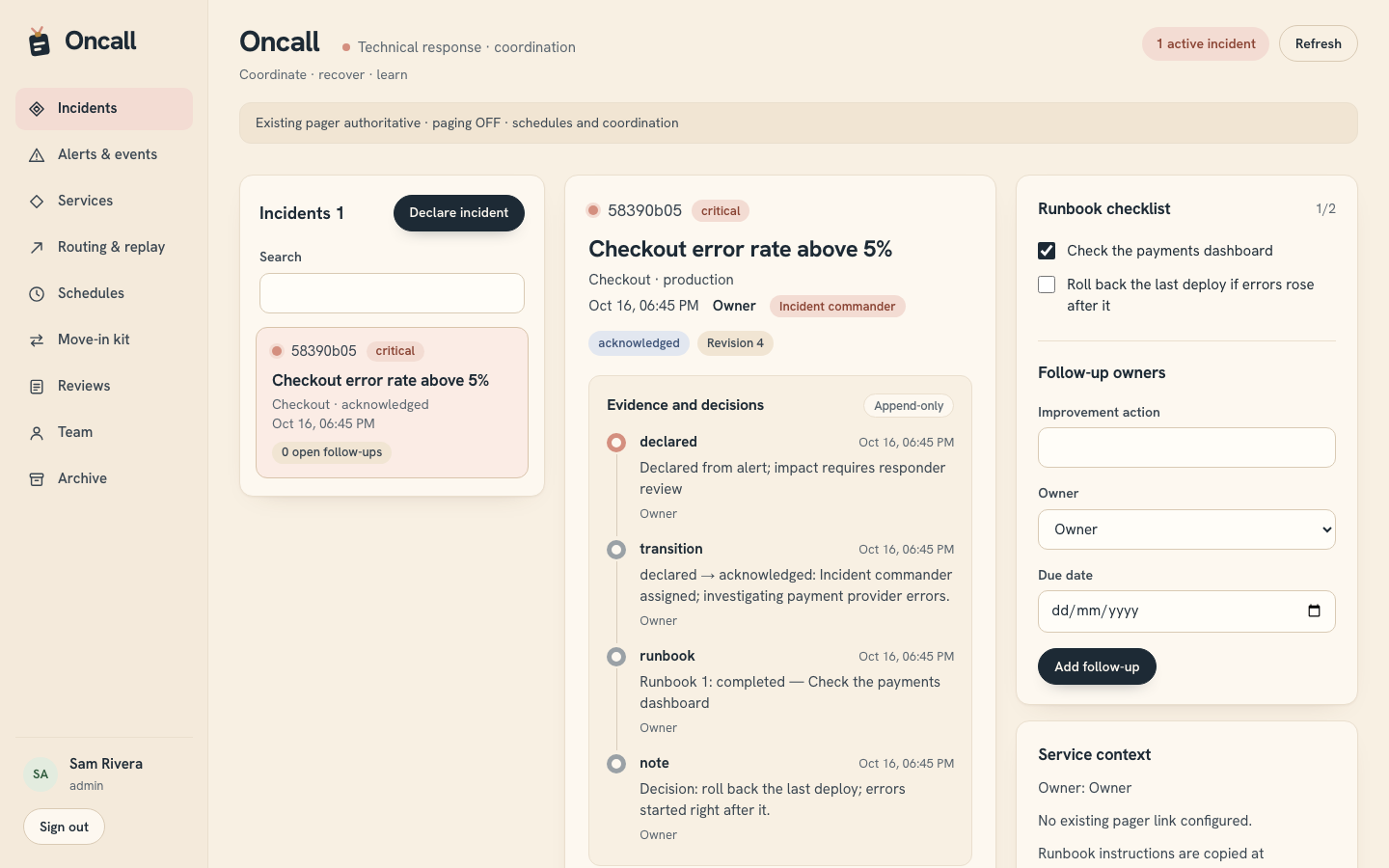
Oncall v0.3.0 at 1440 pixels: a declared incident with its runbook checklist and append-only timeline in local development, from the screenshot named in RELEASE.json.
Outside services
The services the project declares it sends data to, each with its reason.
No outside services are declared.
Scope and limits
What it will not do
- production paging
- provider sends
- autonomous remediation
- independent standby and paging delivery guarantees
Declared limits
- Status
- unmeasured
Requirements
All 22 clauses of Oncall’s CONTRACT.md. They say what the project must do; the handover and verification records say what is built and tested.
OC 22 clauses
OC-001Event identity and alerts Persist accepted events separately from alerts and human incidents. Repeated source event IDs return the original receipt; changed bytes with the same identity conflict. A deduplication key groups active alerts only within its source/service/environment; recovery affects the matching alert and never resolves an incident.OC-002Routing replay Retain routing policy version and explanation at admission. Replay is read-only, returns ordered decisions, and produces no alert, incident or external effect. Unmatched signals remain visible and unowned; suppression reasons remain inspectable.OC-003Roles and authority Incident changes require an active authorized session. Viewer reads; responder coordinates; admin manages services/policies/members/import. Ingest credentials grant no read or human authority. Bearer and signed intake return onlyduplicate, stored eventid, sourceeventId,service,observedAtandacceptedAt(201 accepted; 200 deduplicated). Routing decisions, snapshots and alert identities stay behind session-protected read/export doors. Revocation takes effect on the next request. Every mutation enforces current authority server-side.OC-004Incident state transitions Incident state transitions are explicit. Acknowledgement assigns responsibility. Resolution requires recovery evidence and a summary, independently of alert recovery. Optimistic revision checks reject stale edits. All accepted changes append an attributed timeline transactionally with state.OC-005Copied runbooks Runbooks are copied into the incident at declaration; future service edits never silently rewrite incident instructions. Follow-ups carry owner, due date, open/completed state and completion evidence. Resolved incidents retain open work and editable review.OC-006No outbound incident effects No paging provider notification, AI call, production action or Lamp publication occurs in release 1. Configured remote mail sends sign-in links only. Handoffs are minimum summaries with stable identity and visibility; exported draft is explicitly unreviewed. Source links grant no access. External acceptance/delivery/acknowledgement are distinct later records.OC-007Native archive Native archive preserves services, policies, incident/alert/event/timeline identity and attribution, runbook and follow-up history. Validate schema and references before atomic restore. Invalid restore preserves existing data. Do not export authentication secrets/sessions. Released migrations remain immutable; verify prior-data transitions.OC-008User-authored records kept No automatic deletion of user-authored incident records. Owner export/restore is supported. Ingress accepts bounded structured fields, no arbitrary raw body storage; request bytes max 64 KiB. No arbitrary remote fetching or runbook execution. Display user content as text, never HTML.OC-009Accessible interface Keyboard-complete responsive UI, labelled fields, focus-visible controls, status announcements, readable failure states and contrast. A failed write is visible and never shown as saved. UI unavailable must not be described as pager coverage failure because stage 1 supplies no pager.OC-010Health and honest commands Health checks storage and identifies the deployed version, operating commands describe actual local and hosted effects, and acceptance records distinguish local evidence from remote/provider/pilot outcomes. Capacity promises require measured evidence.OC-011Calendar-day rotations Named-zone calendar-day rotations retain fixed primary/backup member slots. Hand-offs use the wall minute plus integer civil days, not fixed elapsed seconds. Repeated minutes explicitly choose earlier, later or reject; nonexistent/rejected boundaries produce visible gaps. Override intervals include their start and exclude their end; overlap in the same role is rejected. Inactive/viewer/missing members do not shift slots. A duplicated primary/backup assignment leaves backup unavailable.OC-012Paging off Paging is OFF. Every delivery attempt refuses with an explanation that an independent standby and real-phone drill are required. No paging provider sends, synthetic sends, cron delivery, SMS, voice or push are performed. Existing pager is authoritative. Escalation policies are inspectable configuration data, not active timers.OC-013Held history stays historical Held synthetic job/receipt/callback identities remain historical data. Restore pauses pending jobs. Historical acknowledgement and explicit cancellation retain attribution; resume and new timer starts refuse while paging is OFF. An acknowledgement never proves recovery.OC-014Side-effect-free previews Schedule preview, now/next and replay are side-effect-free; actual historical delivery claims remain labelled synthetic. Nothing in this release certifies production delivery.OC-015Strict module archives Strict module archive validation and atomic replacement remain supported. Imported pending historical jobs pause. Scope and local capacity limits remain explicit.OC-016Recovery checkpoint A paired recovery checkpoint captures coordination and scheduling records with both revisions in one consistent storage snapshot, excludes authentication, and validates its envelope and intrinsic record integrity. Explicit current-admin restore replaces both datasets atomically, pauses imported pending jobs, preserves the current-password mapping rule and revokes prior authority exactly as coordination restore does. Missing references in retained paused/finished history remain evidence, never dispatch authority; missing references for pending jobs are invalid. Invalid input, capacity failures, storage failure or losing concurrent writes preserve the previous complete state and cannot revoke a winning restore's new session. Verify the actual emitted Worker/D1 and private local CLI workflow before claiming this target implemented.OC-017Reviewed handoffs Persist explicitly authored, unsent handoff copy with an explicit intended audience, immutable incident/service snapshots and canonical content hashes. Preparation and review actions have stable identities that conflict on changed content. Only current active responders/admins prepare, review or withdraw; viewers inspect permitted internal records and admins restore. A review binds exact copy and source versions, becomes ineligible on source drift or a recovery hold, and never grants sending, publication, recovery verification or independent-review authority. Withdrawal is terminal and preserves attributed append-only history. Keep OC-006 and historical unreviewed envelopes unchanged. Use separate additive handoff storage/archive bounded to 64 records, 128 history entries per record, 128 KiB per record and 1 MiB aggregate. Explicit checkpoint version 2 includes handoffs; version 1 remains supported. Restore retains historical identities and holds active approvals atomically alongside existing recovery and credential/session safeguards. Invalid input, capacity/storage failure or losing concurrent writes preserve the complete prior state. HANDOFF-STAGE.md defines retained snapshots, eligibility and permissions; transfer proof exercises the protected HTTP review and restore flow. No provider send, remote fetch or Lamp publication is authorized.OC-018Maintained root commands Maintained root seed commands use the pinned Base installer, owner identity, dev identity and theme. Ordinary email-link sign-in is kept and tested independently of dev identity. Setup creates no example incident or service. Release 1 supports hosted coordination beside the existing pager without an independent standby; portable SQL batch bindings are required.rer deployverifies deployment identity, claims the configured owner automatically and retires the setup token. Hosted email-link sign-in requires a configured remote mail provider. Removal with the same Cloudflare credentials deletes only recorded deployment resources and verifies that they are gone. On local and hosted apps, the configured owner uses native email links, while admin-created team members use installation-local workspace names and passwords at/signin/local; no invitations are sent. Local dev identity never grants hosted access, and anonymous first-admin bootstrap at/api/setupremains loopback-only.OC-019Additive upgrade The additive upgrade removes the one-row coordination store after migrating every entity and original array order to relational tables. Released migrations stay unchanged. Held passwords and identities are preserved. New Base identity cannot silently claim held coordination data.OC-020Now/next and calendar feed Now/next explains current coverage and each role's next effective hand-off. The private ICS feed uses the same resolved UTC boundaries including overrides/gaps and exports primary/backup separately. It requires a current session; default window is seven days, explicit windows are bounded to 31 elapsed days. Calendar downloads carry no public bearer access. Alert intake records immutable events with scoped source credentials; intake never starts paging.OC-021Move-in preview Opsgenie then PagerDuty file move-in uses Base import-kit D1. Preview writes zero rows. A current administrator must review the exact source fingerprint before applying. Users are matched by normalized email and grant no login rights; schedules and policy data stay paused. Original bytes, unmapped fields, rejected objects, journal and provenance are retained. Every unmappable rotation/rule is named; no partial rotation approximation is allowed. Missing detail exports reject. No account/API calls or routing credentials are activated.OC-022Resume and undo Journaled imports support bounded resume after restart and explicit undo. SQL checks current actor/session/admin authority inside publication and reversal. Changed source identities conflict; duplicate unchanged sources are idempotent. Undo removes only unchanged attributed native objects; edits are preserved with an explicit conflict. Invalid input or failed publication leaves prior committed state unchanged; partial progress remains visible and resumable.
View as agent
These publisher documents are copied unmodified from the release. Site presentation summaries and historical screenshots are attributed separately on this page. An agent evaluating Oncall can read them instead of the page.
seed.json- The manifest: capabilities, outside services, extension points, limits, operating cost and deployment needs.
CONTRACT.md- The requirements on this page, in source form.
AGENTS.md- Instructions for the coding agent that maintains an installation.
README.md- Source setup, available commands and implementation status.
OPERATIONS.md- How the project is set up, operated and deployed.
ACCEPTANCE.md- What the publisher accepts as a finished release.
Every project, with its availability, is in /agents/catalogue.json; the agents page describes the machine-readable files.