Penny
Available
Turn customer feedback into clear product priorities, roadmaps, and release updates.
Penny is available as MIT-licensed source for self-hosting. See its public source and release documents for setup. Business can also install and run projects for invited accounts; the app shows whether it offers Penny before checkout.
Run Penny on your own computer with one line:
npx -y @runeditrun/rer dev just-every/run-pennyIt clones the public source, installs it, sets up a local owner and starts the app; nothing is deployed. To set up without starting, run npx -y @runeditrun/rer setup just-every/run-penny. Without Node 22 or later, run curl -fsSL https://runeditrun.com/install.sh | sh -s -- dev just-every/run-penny.
For HappyToHelp: Assisted is in early access; Managed is in early access.
- Category
- feedback
- Licence
- MIT
- Version
0.1.4- Requirements
- 114 clauses
- Release signature
- Signed by just-every · key
rer-ed25519-5a42fb9c9c4f8acb2b32386e9e40461c· statement - Target release
- v0.1.4 · published
- Publisher’s stage
- requester-board-notification-candidate
- Instead of
- Canny, UserVoice, Productboard
Screenshots
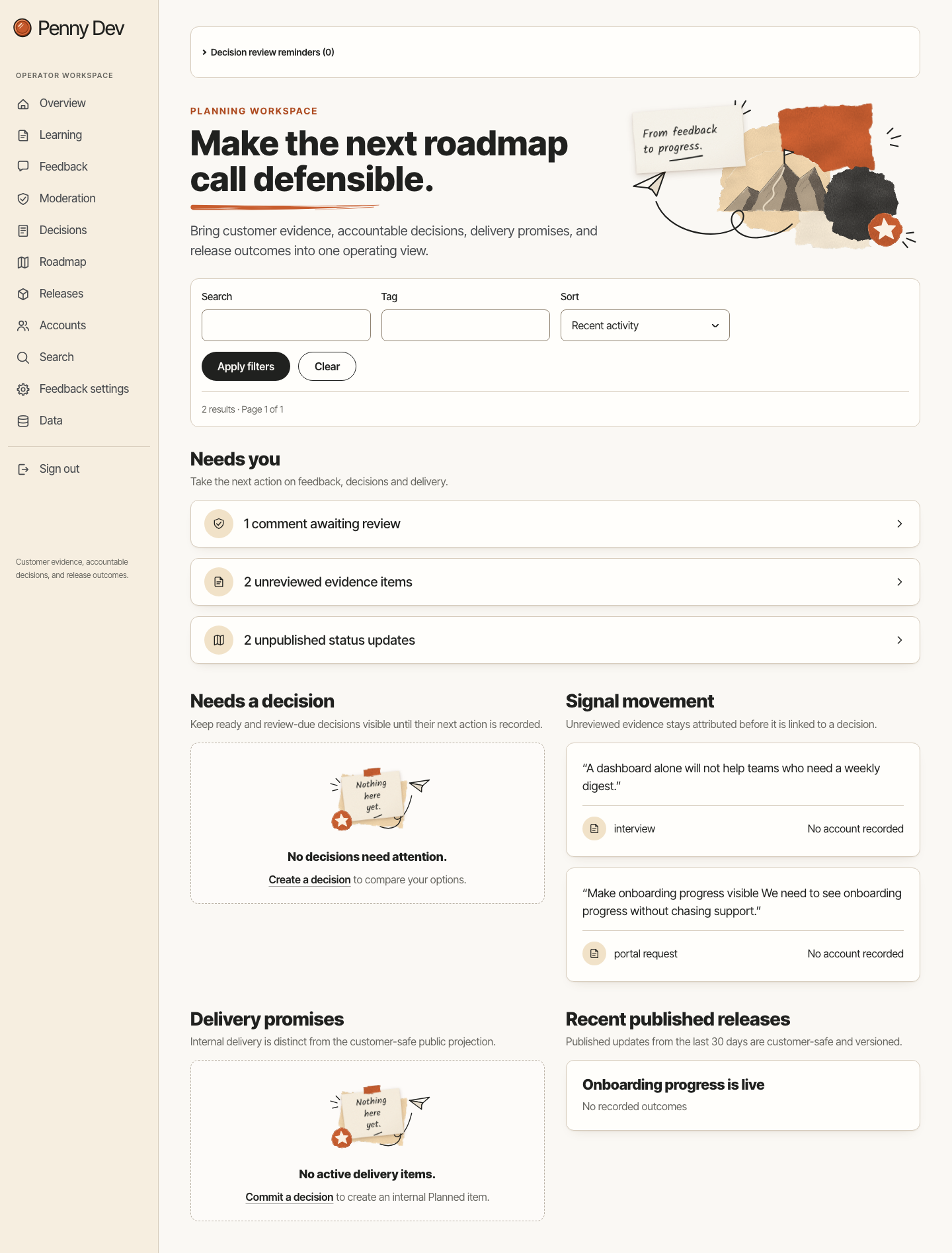
Penny planning workspace overview at 1440 pixels in local development. This is the screenshot committed with v0.1.1; the v0.1.4 RELEASE.json names the same file, committed unchanged at the listed v0.1.4 revision.
Outside services
The services the project declares it sends data to, each with its reason.
transactional-email- Selected Base SendGrid or Resend transport sends operator links, requester verification and customer-safe requester notifications. Provider acceptance is not inbox proof. Resend receives each delivery key as its Idempotency-Key and suppresses a duplicate within 24 hours; SendGrid's delivery key is correlation only, so REL-007 provider suppression is unsatisfied for SendGrid. Ambiguous sends are held for operator reconciliation and never replayed.
integration-egress- Outbound webhook, Slack and tracker creation require an installation-owned enforcing RPC service binding. Current owner deployment does not provision that optional binding.
public-webhooks- An operator-selected HTTPS receiver can receive approved public events through the enforcing integration transport.
slack- An operator-selected Slack incoming webhook receives selected approved public events through the enforcing integration transport.
linear- Operator-selected issue creation uses a configured Linear team and API token through the enforcing integration transport. Signed inbound issue state remains private delivery evidence; existing issue linking requires no API token.
jira-cloud- Operator-selected Jira Cloud issue creation uses the configured site, project, issue type and API token through the enforcing integration transport. Signed inbound issue state remains private delivery evidence; existing issue linking requires no API token.
orbit-learning-source- Scoped cancellation learning reads only the exact evidence targets an operator selected, from the pinned Orbit installation's rer-delegation/1 crm.evidence.read grant, through the installation-owned enforcing RPC service binding PENNY_LEARNING_EGRESS. The evidence lives in that other installation; there is no discovery, CRM enumeration or provider write, and an absent binding or section refuses work.
learning-model- The configured OpenAI Chat Completions model prepares the cited evidence comparison, clarification and internal brief that no owned primitive can produce, through the same enforcing RPC service binding. Each call reserves its budget first and is never retried; an absent binding or section refuses work.
zendesk-proxy-sidebar- Optional private Zendesk ticket-sidebar app loads the official ZAF SDK inside Zendesk. Zendesk’s secure server proxy uses an installation-held Penny API key to read selected request/customer choices and record explicitly reviewed proxy votes. Penny makes no outbound Zendesk call.
release-video-embeds- Readers may explicitly load a release video from the approved YouTube privacy-enhanced or Vimeo player origin. No provider request occurs before that choice.
Scope and limits
What it will not do
- Multiple workspaces, businesses, or tenants
- Granular roles, permissions, and approval chains
- A CRM, support inbox, survey, NPS, community chat, or general-purpose forum
- Requester self-voting without verified identity; operator-recorded proxy attribution never grants identity
- AI outside the bounded source-cited cancellation investigation in LEARN-001 through LEARN-006; no scoring, ranking or automatic merging
- A combined priority score or automatic ranking of requests, bets, or roadmap items
- Automated CRM/support breadth, review scraping and call ingestion beyond owner-selected Orbit evidence targets in LEARN-001
- Imports from arbitrary feedback tools beyond the documented saved feedback CSV/API-response format
- A script-tag feedback widget or in-app capture SDK beyond the embeddable portal in REQ-027
- Bidirectional synchronisation with delivery trackers
- Portfolio capacity planning, Gantt charts, sprint management, and public delivery estimates
- Account-specific public roadmaps
- Native mobile applications
Extension points
Optional conveniences for common changes. Owners can change any source, including core logic, schema and infrastructure.
app.page.v1app.navigation.v1app.settings-section.v1job.consumer.v1cron.task.v1operator.management.v1request.moderation.v1request.visibility.v1request.vote-eligibility.v1decision.commitment.v1roadmap.publication.v1release.recipient-eligibility.v1requester.notification.v1evidence.created.v1evidence.linked.v1request.created.v1request.moderated.v1request.published.v1request.declined.v1request.merged.v1request.unmerged.v1decision.committed.v1decision.revised.v1decision.review-due.v1roadmap.status-changed.v1roadmap.status-update-published.v1release.published.v1release.delivery-failed.v1release.outcome-recorded.v1overview.after.v1evidence.list.after.v1evidence.detail.after.v1account.detail.after.v1request.detail.after.v1decision.brief.after.v1decision.alternatives.after.v1roadmap.item.after.v1release.detail.after.v1portal.request.detail.after.v1mail.sender.v1
Declared limits
- Provenance
- All values are estimates for backend design and must be replaced by load-test results before the first release. Latency that defines a feature lives in its contract clause, not here.
- Status
- estimated-not-tested
- Operators
- 20
- Boards
- 100
- Tags
- 500
- Accounts
- 25,000
- Requesters
- 250,000
- Evidence Items
- 1,000,000
- Public Requests
- 100,000
- Votes
- 2,000,000
- Comments
- 1,000,000
- Decisions
- 25,000
- Roadmap Items
- 25,000
- Releases
- 10,000
- Recipients Per Release
- 50,000
- Public Read Requests Per Minute Per Ip
- 120
- Public Asset Requests Per Minute Per Ip
- 1,200
- Public Chrome Requests Per Minute Per Ip
- 600
- Public Write Requests Per Minute Per Ip
- 30
- Public Writes Per Minute Per Identity
- 20
- Identity Actions Per Minute Per Ip
- 10
- Identity Verifications Per Hour Per Email
- 5
- Magic Link Requests Per Hour Per Email
- 5
- Mail Events Per Minute Per Ip
- 600
- Request Submissions Per Hour Per Identity
- 10
- Upload Bytes Per File
- 10,485,760
- Upload Bytes Per Request
- 26,214,400
- Upload Types
- image/png, image/jpeg, image/gif, application/pdf
Requirements
All 114 clauses of Penny’s CONTRACT.md. They say what the project must do; the handover and verification records say what is built and tested.
HOME 2 clauses
HOME-001Public feedback portal Superseded by HOME-002; the portal's guarantees live under REQ-001. The public board at/portal/feedbackidentifies the workspace and gives the owner's configured one-line portal description; public feedback, roadmap, and updates follow REQ-001, ROAD-006, and REL-010. It makes no vendor, pricing, testimonial, or metric claims and exposes no operator-only data.HOME-002Public product landing At/, the deployment serves Penny's public product page, rendered on the server as the finished page. It has a header with Penny's coin mark and name and links to the documentation at/docs, the public board at/portal(which redirects to/portal/feedback), the source repository and/signin; a hero with the page's one heading, a supporting line and links to/docs/installand/docs; and sections, each with a decorative paper-collage drawing of Penny's own screens, for the moderated public board, evidence-based decisions, closing the loop with followers, private commercial context, and self-hosted ownership the owner may change with their own agents. A closing call to action repeats the two links, and the footer repeats the navigation. Its copy names only capabilities whose clauses aredonein the status table at the end of this contract and shows no pricing, testimonials, customer logos, metrics or integrations Penny does not ship; drawn labels use the portal's own status and sort vocabulary. The public board, roadmap and updates remain the portal under/portal(REQ-001, ROAD-006, REL-010). The page reads no workspace or operator data, sets no cookie, and loads no resource from another origin: its fonts, styles, script and drawings are served by the deployment itself. Its optional footer credit, "Powered by Penny · runeditrun.com", is visible by default andshowPoweredByCreditinsrc/ext/config.tsturns it off; the credit is a plain link that adds no telemetry or phone-home. Motion is optional and plays once on load; it never loops, is off under reduced motion, and never hides content: without script, with reduced motion and after motion ends, every section is fully visible.
DOCS 1 clause
DOCS-001Public documentation The public paths/docsand/docs/<slug>serve Penny's first-party documentation: the Markdown files thatdocs/site.jsonlists as published, in the sections and order it gives, which is the only navigation. The Markdown is rendered to HTML at build time by a Vite plugin, in a build and in development, and never in the Worker or the browser; each page is its own lazily loaded chunk that the Worker renders per request. A page has its title as its one top-level heading, under the same header as the product landing (HOME-002): Penny's coin mark and name linking to/, then links to the docs (marked as the current section), the public board at/portal, the source repository and/signin, of which a phone keeps the mark, the name and sign-in; the landing's footer repeats them. It has a section menu, an on-this-page list, previous and next links, tables in labelled scrollable regions and an Edit-on-GitHub link; after the page loads, moving between docs pages is client-side navigation. Every Markdown file at the repository root, underdocs/and as a top-level<directory>/README.mdis either published or listed in the manifest as GitHub-only with a reason, and an unlisted file fails verification. A broken internal link or anchor, an image outsidedocs/media/or an absolute build-machine path fails the build; raw HTML in the Markdown is shown as text, never rendered. The documentation reads no workspace record, requester or operator identity or session, sets no cookie and loads only same-origin resources. An unknown or nested slug answers a404with no article.
OPS 5 clauses
OPS-001Roles Every operator holds one role. Owner: everything, including installation configuration, ownership handover (OPS-002), integrations, export and erasure. Admin: all product work plus settings (including branding, INT-007, and sender identity, NOTIFY-013), boards, integrations, automation rules and the roles below Owner. Product manager: all product work on evidence, requests, moderation (including editing and removing published content, REQ-038), decisions, roadmap and releases. Contributor: the seat for support, sales and success staff, who capture evidence, record proxy votes (CAP-014), comment internally and read product records, but cannot moderate, publish, commit, change settings or see commercial fields unless granted (ROLE-001). Viewer: read-only. Contributor and Viewer seats are unlimited. Each role is checked in the business transaction like current authority, and a role change applies to the next request. Operators invited before the full roles system ships become Product managers. Current operators share product access; workspace clock settings admit Owners and Admins (OPS-008), while other configuration remains owner-only. Policy:operator.roles.v1; default: the five roles above. Acceptance: A base and browser journey signs in one operator per role and attempts every guarded action through its route and its UI: a Viewer is refused every write with 403; a Contributor captures evidence, records a proxy vote and comments internally but is refused moderation, publication, commitment, settings and every commercial field; a Product manager is refused settings, integrations and roles; an Admin is refused ownership handover, export and erasure; each refusal changes nothing; a role change takes effect on the operator's next request.OPS-002Management Operators are invited and removed in settings. The operator configured at setup can be removed only by themselves. Policy:operator.management.v1; default: any operator may invite or remove any other operator.OPS-003Overview The operator home lists decisions that are ready or review due, evidence that is unreviewed, roadmap items that are Planned or In progress, and releases published in the last 30 days with their outcome totals. Every figure links to the records it counts, and a section with no records names what is absent and links to the action that creates one.OPS-005First-run setup The signed-in owner whose setup is unfinished completes it at/setup, and every/appdocument and client-side app navigation sends that owner there first. Finishing it opens the app, and later visits to/setupgo to the app. A signed-out visitor to/setupis sent to sign-in and back, and a signed-in operator who is not the owner is never sent there. Setup completion is installation state recorded once by the owner under the same-origin and authority checks of the business transaction; it is not portable domain data and does not transfer in an archive. An installation that already has an active owner is treated as finished. Afterrer setup, localrer devopens automatically signed in as the owner and returns them to/setupuntil it is finished; local development has no outbox and silently suppresses mail. Setup cannot finish until the owner has chosen the workspace timezone and seen the requester quiet hours (OPS-008) and entered the company name (INT-007) and the business postal address (NOTIFY-013).OPS-004Global search Operators can search request titles and descriptions, evidence wording, decision questions and rationales, roadmap item titles and summaries, release titles and bodies, requester display names and email addresses, and account names. The first page of results returns within 500ms.
EVID 10 clauses
EVID-001Capture Every portal submission creates exactly one evidence item in the same transaction (REQ-003). An operator can also record an evidence item, whose source is one of sales call, support conversation, interview, email, or a free-text label the operator supplies.EVID-002Provenance Every evidence item stores its source, its original wording, the observed time, and the operator or portal submission that created it. The submitting requester or named speaker and the account are nullable, are set only from what the recorder supplies, and are never inferred.EVID-003Review lifecycle New evidence is unreviewed. An operator can link it to a request or to a candidate bet in a decision brief (DEC-002), create a request or a decision from it, or mark it reviewed with a reason, and can return any reviewed item to unreviewed. Linking alone does not mark it reviewed.EVID-004Non-destructive linking One evidence item can be linked to any number of candidate bets, and each link is recorded as supporting or contradicting that bet. Linking, unlinking, tagging, merging a request, and committing a decision never alter or remove an evidence item or any of its versions; only an operator deleting it does.EVID-005Account context An account has a name, an internal owner, optional commercial fields for revenue, renewal date, and health, its requesters, its evidence in observed-time order, and its linked requests and decisions. Evidence recorded against an account appears on that account, and on every request and decision the same transaction linked it to, when that transaction commits.EVID-006Private commercial data No field of an account (EVID-005), no evidence source attribution, and no internal note (REQ-032) appears in a portal response, on a public page, in page metadata, in a sitemap, or in the subject or body of a requester notification.EVID-007Duplicate suggestions When an operator records evidence or a requester types a request title, Penny returns within 500ms up to 5 existing requests ranked by term overlap between the typed title and stored request titles and descriptions, and names the matched terms for each. A requester is shown published requests only. Matching is lexical and deterministic and keeps working when no model is configured; AI-001 adds meaning-based suggestions beside it. Penny never links or merges without an explicit operator or requester action, or an auto-link or auto-merge rule an owner enabled (AI-002, AI-003).EVID-008Evidence attachments An operator can attach files to an evidence item within the limits inseed.jsonunder BASE-INPUT-003. An evidence attachment is readable only by an operator session and is never served from a public path, whatever the publication state of a linked request.EVID-009Tags Operators create, rename, merge, and delete tags and apply them to evidence items and requests. A tag is operator-only, filterable in every operator list, survives a request merge, and is included in the export.EVID-010Versions Editing an evidence item's wording writes a new version and leaves every earlier version readable to operators. The item's own ID never changes.
REQ 32 clauses
REQ-001Public portal The portal serves published requests, a request detail page with its discussion, the public roadmap, and published releases. Policy:request.visibility.v1; default: any visitor may read all four without signing in.REQ-002Requester identity Submitting, voting, commenting, following, subscribing, and recording an outcome each require either an email address verified under REQ-023 (by emailed link, or by Google or GitHub sign-in under REQ-039) or a host-signed identity under REQ-031 (from a parent frame, the widget, or WIDGET-008's sign-in redirect). A portal response shows the requester's chosen display name and never their email address or account.REQ-003Submission A requester submits a title, a problem description, an optional free-text proposed solution, an optional free-text impact statement, a board (REQ-018), a category where the board uses them (REQ-034), and optional attachments; on a board with vote subscriptions on, the form states before submission that the author will get updates (NOTIFY-011). The submission atomically creates one unreviewed evidence item and one request awaiting moderation; the request is not public until an operator publishes it, except on a board whose owner turned on auto-publish (REQ-033). Policy:request.moderation.v1; default: each board's moderation setting in settings (REQ-033); on a board without auto-publish an operator reviews every requester submission, edit, and comment before it becomes public.REQ-004Duplicate prevention Before a requester submits, the portal shows the suggestions from EVID-007 with a vote control and a follow control on each. Choosing one applies that vote or follow and discards the draft, creating no request, evidence item, or moderation item.REQ-005Publication An operator publishes a moderated request by approving its public title, description, board, category (REQ-034), requester display name, and each attachment separately (REQ-011). The published record contains only the approved fields; after publication an operator edits them under REQ-038.REQ-006Voting A requester identity has at most one vote on a request and can remove it. The vote total is the count of distinct current voters, and a vote is accepted only while the request's public status is Open, Under review, Planned, or In progress (REQ-016). The author's vote recorded at submission is NOTIFY-011's and counts once like any other. Policy:request.vote-eligibility.v1; default: any verified requester may vote and every vote counts once.REQ-007Discussion Verified requesters and operators can comment on a published request. A requester comment is held underrequest.moderation.v1and becomes public only when an operator approves it, or on submission on an auto-publish board (REQ-033); an operator comment is public when posted. Threaded replies and images in comments are REQ-037.REQ-008Merge An operator can merge a duplicate request into the canonical request, which is the one that survives. The operation atomically moves the duplicate's evidence links, approved attachments, comments, and followers, collapses the combined votes so each identity counts once, keeps the duplicate's title and source as merge history, and answers the duplicate's public URL with a 301 to the canonical request. Merging a request that is itself a duplicate merges it into the canonical request at the end of its chain.REQ-009Unmerge An operator can reverse a merge. Penny restores the duplicate request's own content, votes, comments, followers, and evidence links, leaves anything added to the canonical request after the merge on the canonical request, and records the reversal.REQ-010Follow and consent A verified requester can follow and unfollow a published request. Submitting and voting present an unticked "Email me updates" control and grant no email permission on their own, except that on a board whose owner turned on vote subscriptions (NOTIFY-008) the vote control says that voting subscribes and the vote itself follows, and submitting subscribes the author (NOTIFY-011). Following, or ticking that control, stores a timestamped permission record for the verified address, which is what makes the identity eligible under REL-004.REQ-011Portal attachments A file submitted with a request is operator-only until an operator approves that file for publication; rejecting a file records a reason for operators and does not reject the request. While both the parent request and the file are published,GET /api/public/attachments/:idserves it with its declared content type and, for the image types inseed.json → limits.uploadTypes, an inline disposition so it renders on the request page; this supersedes BASE-INPUT-003's download disposition for published image attachments only. In every other state that path returns 404.REQ-012Portal search and browse Visitors can search published request titles and descriptions, browse one board at a time, filter by public status and by category (REQ-034), and sort by vote total, by most recent public activity (the request's latest published comment, status update, or vote), by newest, or by trending, meaning new votes and published comments in the last 14 days with each day's activity weighted by recency and ties broken by vote total. The first page returns within 500ms, and no result, count, or facet includes an internal board, an unpublished or removed request (REQ-038), or a held or removed comment.REQ-013Submission idempotency A public submission accepts an idempotency key. Repeating the same submission with that key returns the original request and evidence result and creates no second record of any kind; the same key with a different body returns 409. Keys are retained for 30 days and hold no personal data.REQ-014Identity failure A host-signed identity is expired when its signed issue time is more than 24 hours old or more than 5 minutes in the future. An identity that is expired, or whose signature does not verify, is rejected for every identity-required action, changes no data, and reveals no account or identity match; the visitor is offered email verification (REQ-023) instead.REQ-015Status updates An operator can publish a status update on a published request. It is rendered distinctly from comments, can be pinned above them, enters the request history, and notifies followers under NOTIFY-001. Setting a request's status (REQ-036) publishes one.REQ-016Public status A published request has exactly one public status: Open, Under review, Planned, In progress, Shipped, or Declined. A declined request is Declined (REQ-017). Otherwise two sources can set it: the direct status an operator sets on the request (REQ-036), including one a migration lands (MIG-001), and the status its approved roadmap mapping projects under ROAD-003. Whichever of the two changed most recently wins: approving a mapping (ROAD-004) and each later transition of the mapped item count as changes of the mapped status at that moment, and a later direct status overrides the mapped one until the mapped item's next transition, the rule DELIV-006 uses for tracker changes. Withdrawing the mapping or dropping its item leaves the direct status, or Open if none was ever set. A request with neither source is Open. The operator request page shows which source the current public status comes from. Acceptance: A base test: a request with no mapping reads Open, then Planned after a direct set; approving a mapping to an In progress item makes it In progress; a later direct set to Planned wins until the item moves to Shipped, which then wins; withdrawing the mapping returns the last direct status; declining wins over both, and reversing the decline restores the status this rule gives; every public payload agrees within 5 seconds.REQ-017Decline An operator can decline a published request. A decline without a public reason is rejected. Declining sets the public status to Declined, adds the reason to the request history as a status update (REQ-015), and refuses new votes and requester comments while leaving existing ones visible and counted. Reversing a decline restores the request's previous public status. Decline and reversal ship through the operator request controls; repeating a decline with another reason preserves the prior direct or mapped status for reversal. Acceptance: Route tests and the 1440/390 customer and operator journeys intests/base/request-status-workflow.test.tsandtests/browser/request-decline.mjsprove the required public reason, Declined status and history, refusal of new votes and comments, retention of existing votes and discussion, and restoration after repeated decline.REQ-018Boards Every request belongs to exactly one board. Operators create, rename, reorder, and archive boards in settings and can move a request to another board, which keeps its votes, comments, followers, and evidence links. An archived board leaves portal navigation, keeps its published requests reachable at their URLs, and refuses a new submission with 409.REQ-019Internal boards Each board is public or internal. A request on an internal board never appears in a portal response, on the public roadmap, in a release, or in a requester notification, whatever its own publication state. Moving a request to an internal board withdraws it from the portal within 5 seconds and its public URL returns 404.REQ-020Requester's own content A requester can edit the title and description of their own request and the text of their own comment. An edit to already-public text re-enters moderation underrequest.moderation.v1, and the previously approved text stays public until the edit is approved or rejected; on an auto-publish board (REQ-033) an unflagged edit is public on submission and the earlier text stays in the request's history for operators.REQ-021Requester withdrawal A requester can withdraw their own request. A withdrawn request leaves moderation or the portal, its public URL returns 410, and its votes stop counting. Its evidence item survives under EVID-004, marked withdrawn.REQ-022Blocking a requester An operator can block a requester identity. A blocked identity's submissions, votes, comments, follows, and outcome responses are refused with 403; their published requests and comments are hidden from the portal but kept for operators; and their votes stop counting toward totals. Unblocking restores all of it. Block and unblock ship in the private requester directory, and the server checks existing sessions on each participation write. Acceptance:tests/base/requester-blocking.test.tsand the 1440/390 journey intests/browser/requester-blocking.mjsprove submission, vote, comment, follow and outcome refusal, public hiding and vote-count exclusion with operator records retained, and restored visibility, counts and participation after unblock. Refusing the audit write rolls back the block or unblock.REQ-023Email verification A requester verifies an email address by following a single-use link sent to it; the link expires 30 minutes after it is sent and fails after one use. The verified session is a browser-local token created at the requester's first interaction and expiring after 30 days without use, so no portal surface sets a cookie. An identity-required action attempted before verification is held for 24 hours, applied on the first verification of that address, and otherwise discarded, and it creates no vote, public record, or notification while held.REQ-024Requester identity merge An operator can merge two requester identities. The survivor keeps both verified addresses and all requests, comments, follows, permission records, and suppression state; votes for the same request collapse to one; and the merge is recorded. A merge creates no new vote and no new permission record.REQ-025Requester activity A verified requester can see their own requests with their current moderation state and public status, their votes, their follows, and their own comments including held and rejected ones, and can unfollow, mute, or change their update subscription (REL-012) from that view. Status: done. Requests, votes, follows, comments, unfollow, mute and the REL-012 updates-subscription control ship in the requester activity view. Changing the subscription preserves the requester’s contributions; route and 1440/390 browser journeys cover persistence, failure/retry and expired sessions.REQ-026Demand attribution For any request, operators can see every current voter's display name, verified address, and linked account, and the vote total broken down by account. The operator view shows the vote total (proxy votes marked, CAP-014), the linked-evidence count, and the distinct-account count as separate figures beside SEG-007's value figures, and combines them into no score; only a prioritisation view an operator builds under PRIO-003 may combine them, with every input shown. None of it appears in a portal response. Status: partial. The private supporter view shows each current voter’s display name, vote date, every verified address and linked account, with native and historical UserVoice proxy marks. It shows per-account vote totals and separate vote, linked-evidence and distinct-account figures. The first 50 supporters appear on expansion; Show more reveals 50 more at a time until the complete history is visible, with no 100-person cap. CAP-014’s native proxy recording ships from the inbox, request page and Zendesk edge. SEG-007’s ARR/MRR, opportunity and churn value figures beside these counts remain required.REQ-027Portal embedding The portal can be embedded in an iframe on the origins inpublicOriginAllowlistunder BASE-PUBLIC-002; a request to frame it from any other origin is refused.REQ-028Request queue Operators can list every request, including unpublished ones, filtered by moderation state, board, public status, tag, linked decision, and account, and sorted by vote total, most recent activity, or age. The first page returns within 500ms.REQ-029Operator-authored request An operator can create a request from one or more evidence items. It skips moderation, records the operator as its author, links the evidence it was created from, and becomes public only through REQ-005.REQ-030Moderation verdicts An operator can approve, edit and then approve, or reject with a reason any request or comment awaiting moderation. A rejected item never becomes public, counts toward no public total, stays visible with its reason to its author and to operators, and notifies its author only when the operator chooses to. This private author-only notice requires current verified request-specific email consent and respects suppression, mute, unsubscribe and quiet hours; it does not publish the rejected content or create follower notifications.REQ-031Host identity claims A host-signed identity may assert a display name, an email address, and an account identifier and name. A valid signature marks that address verified without a further challenge and links the requester to the matching or newly created account; any asserted commercial field is stored operator-only under EVID-006.REQ-032Internal notes Operators can add a note to any request. A note is rendered distinctly from an operator comment and never appears in a portal response, page metadata, a release, or a notification.
DEC 8 clauses
DEC-001States and queue A decision is draft until its brief has a question, an owner, at least one candidate bet, and at least one linked evidence item, at which point it is ready; committing makes it committed, and DEC-007 makes a committed decision review due. The decision queue lists every decision in each state with its owner, last action, review date, and linked-evidence count, and a decision changes row rather than leaving the queue when its state changes.DEC-002Brief A candidate bet is one named option a decision could commit to, and a bet has at most one internal roadmap item. A decision brief holds a question, an accountable owner, its linked evidence and accounts, its candidate bets with the counter-evidence and assumptions for each, a confidence level of low, medium, or high, a review date, and the requesters currently eligible under REL-004 through its mapped requests.DEC-003Comparable bets Every candidate bet in a brief shows the same dimensions: affected requesters and accounts, the count and most recent observed time of its supporting evidence, its contradicting evidence, urgency, delivery shape, and an observable success measure. Penny stores and displays no combined score and no automatic ranking of the bets.DEC-004Commitment Committing requires a selected bet, a rationale, an owner, a confidence level, and a review date, and committing a brief with fewer than two candidate bets additionally requires a recorded reason why no viable alternative exists. The operation records the declined bets and an evidence snapshot made of the evidence IDs, evidence-version IDs, and DEC-003 dimensions as they stood at that moment, without altering the evidence itself. Policy:decision.commitment.v1; default: any operator may commit.DEC-005Commitment effects Committing atomically marks the decision committed, creates or updates the selected bet's internal roadmap item as Planned, leaves the declined bets' roadmap items unchanged, and links the decision to that roadmap item. Commitment writes no public field itself; whether the new status reaches the portal is decided entirely by ROAD-004 and ROAD-005.DEC-006Revision A later change of selected bet or rationale underdecision.commitment.v1supersedes the prior commitment as a new decision revision, and the original rationale, evidence snapshot, and declined bets stay readable. A revision that changes the selected bet returns the superseded bet's roadmap item to Exploring and, where that item was published, withdraws its approval under ROAD-004 and prepares a status update draft under ROAD-007.DEC-007Review due A review is complete when an operator records a review note and either a new review date or a revision (DEC-006). A committed decision whose review date has passed inworkspaceTimezonewithout a complete review becomes review due within 1 hour and its owner is notified under NOTIFY-003. Becoming review due changes no roadmap status, no public status, and no selected bet.DEC-008Outcome evidence A requester outcome (REL-008) and any evidence recorded against a linked release appear on the decision as post-release evidence within 60 seconds and do not alter the evidence snapshot that supported the commitment.
ROAD 8 clauses
ROAD-001Internal states A roadmap item is Exploring, Planned, In progress, Shipped, or Dropped. A status change records the actor, time, and reason and adds an activity entry to the linked decision without changing that decision's state. Moving backward is allowed and is recorded as a further transition.ROAD-002Internal record A roadmap item holds its owner, target or release window, linked decision and evidence, account impact, confidence, delivery notes, and its customer-safe title, summary, and status.ROAD-003Public projection An approved roadmap item's public status follows its internal status within 5 seconds of a transition: Exploring is shown as Under review; Planned, In progress, and Shipped keep their labels; a Dropped item is withdrawn from the public roadmap. The projection exposes only the approved title, summary, board, and public status; account names, revenue, internal dates, confidence, rationale, evidence, declined bets, and delivery notes are never projected.ROAD-004Approval is publication A roadmap item and each of its request mappings are internal until an operator approves their customer-safe fields, and that approval alone is what puts them on the public roadmap and on the mapped requests. A published request has at most one approved mapping; approving a second is rejected. Withdrawing approval removes the projection from the portal within 5 seconds, makes its public roadmap URL return 404, and deletes no internal record. Policy:roadmap.publication.v1; default: an operator approves every public mapping explicitly.ROAD-005Commitment mapping The roadmap item DEC-005 creates or updates is internal unless it already carries an approval under ROAD-004. An already-approved item projects its new Planned status under ROAD-003; an unapproved item and its mappings stay private, and commitment never grants an approval.ROAD-006Public roadmap A public roadmap whose source is approved roadmap items groups them under Under review, Planned, In progress, and Shipped and links each to its public request or release. It exposes no unapproved item and no count that includes one. A public roadmap whose source is request statuses follows ROAD-014.ROAD-007Status update draft Every status change of a roadmap item that carries an approval under ROAD-004, and every request decline under REQ-017, prepares a draft customer-safe update naming the new public status and the problem it addresses. The draft carries no internal rationale, commercial context, declined bet, or outcome prompt, and is invisible on the portal until an operator publishes it.ROAD-008Status update publication Publishing that draft adds it to the history of every approved mapped request and queues one notification per update version for each requester eligible under REL-004 who follows one of those requests, deduplicated by identity and subject to the coalescing in NOTIFY-002. Republishing the same version queues nothing further.
REL 13 clauses
REL-001Draft and targets A targeted release draft has one or more targets, each linking one roadmap item in any state to its decision and its approved public request mappings, or one published request directly (REL-018); a draft with no target is an announcement (REL-018). The draft also holds a customer-safe title, a type of New, Improved, or Fixed, one or more subject tags drawn from EVID-009, a body, a publication date, an optional setup or usage link, an author, and, for a targeted release, the wording of the outcome prompt shown with the REL-008 response.REL-002Publication An operator can publish a targeted draft only when it has a title, a body, at least one target, and every linked roadmap item at Shipped; publishing with any linked item in another state is rejected. Request targets and announcements publish under REL-018. Publication makes one versioned update visible on the portal and durably records the complete recipient snapshot (REL-004) before it queues any delivery.REL-003Published wording Published release wording is never overwritten. A correction creates a new version, keeps the earlier version readable by operators, and marks which version the portal shows. A correction changes the portal only; sending it to recipients requires an operator to send it as a new delivery version.REL-004Recipient eligibility and snapshot A recipient is eligible when they hold a verified address and a current permission record, and each eligible identity appears exactly once in the snapshot however many target contexts it has. At publication Penny snapshots every release target and each recipient's linked request or evidence context, and a later merge, relink, or preference change does not alter that snapshot. Policy:release.recipient-eligibility.v1; default: a permission record comes only from following a request (REQ-010), subscribing to updates (REL-012), voting on a board with vote subscriptions on (NOTIFY-008), submitting a request on such a board (NOTIFY-011) or an owner-selected migration carry-over (MIG-007, which makes its address eligible for email without verifying it); voting elsewhere and an operator-entered address grant nothing, and an operator's per-update choice to email captured contacts (NOTIFY-009) adds them to that one snapshot without a permission record.REL-005Customer-safe delivery Release email and release portal content carry only the published release fields and the recipient's own request context. Recipient lists, other requesters, account context, commercial impact, decision rationale, confidence, and declined bets never appear in either. Release email carries the owner's brand header (INT-007) and sender identity and postal address (NOTIFY-013).REL-006Acceptance and retry Publication queues each eligible delivery within 60 seconds of its permitted send time (NOTIFY-002). A failure returned before provider acceptance is retried up to 5 times with exponential backoff over 1 hour and then marked failed. After acceptance Penny never resends automatically. A result the provider leaves ambiguous is marked unknown, shown to operators, and retried under its delivery key (REL-007); a delivery still unknown after those retries is marked failed for BASE-OPS-004. The published update stays visible on the portal in every failure state.REL-007Idempotent delivery and provider events Every release version and recipient has one durable delivery key thatmail.sender.v1passes to the provider as an idempotency key, and the accepted provider message ID is stored against it./api/public/mail/eventsaccepts only signed provider callbacks and deduplicates their event IDs, which are retained for 30 days.REL-008Outcome response A requester in a release's publication snapshot can answer Adopted, Partly adopted, or Not yet for each of its targets, whether or not they have muted or unsubscribed from email. Penny stores one current response per release, requester, and target; changing it records a revision and updates the aggregates without exposing the requester on any public surface. Repeating the same response records no revision.REL-009Outcome coverage Operators can see, per target and for the whole release, the count of each response and the coverage, meaning current responses divided by snapshot recipients, and can see the individual responses. Each current response links through its snapshotted target and recipient context back to the applicable request or evidence, roadmap item, and decision.REL-010Empty feed With no release published, the public updates surface states that there are no updates yet and renders no draft, example, or placeholder entry.REL-011Bounces and complaints A hard bounce or a spam complaint suppresses the address: no further Penny email reaches it until the requester verifies it again, and its permission records are marked suppressed rather than deleted. A soft bounce marks that one delivery failed and suppresses nothing. Suppression removes no vote, request, comment, or portal access.REL-012Update subscription A verified requester can subscribe to every published release from the public updates surface and unsubscribe there or from any notification's unsubscribe link. Subscribing stores a timestamped permission record for that address; unsubscribing withdraws it without removing votes, requests, or follows.REL-013Delivery states A delivery moves through queued, then accepted, then delivered, and can terminate at failed, suppressed, or unknown. An out-of-order provider event never moves a delivery backward along that order and never counts a result twice.
NOTIFY 5 clauses
NOTIFY-001Requester updates A follower of a published request is notified when an operator publishes a status update on it (REQ-015), including a status set under REQ-036, declines it (REQ-017), publishes a status update mapped to it (ROAD-008), posts a public reply on it, approves a requester comment on it (REQ-007) or receives an auto-published one (REQ-033), unless they have muted that request or their address is suppressed. Voters on vote-subscription boards (NOTIFY-008) and subscribed authors (NOTIFY-011) are notified as followers, and a merge notifies under NOTIFY-012. Held or rejected comments, unpublished requests, internal boards, internal notes, and an internal roadmap transition with no published update notify nobody, and republishing the same update version notifies nobody again.NOTIFY-002Preferences, timing, and unsubscribe A notification's permitted send time is the first moment after it is queued at which the requester's preferences and the quiet hours below allow it. Every requester notification carries a one-click unsubscribe link that works without signing in, and a requester can mute one request or all requester email; the preference is checked immediately before each send and removes no vote, evidence, or portal access. Policy:requester.notification.v1; default: hold requester email during the requester quiet hours the owner sets under OPS-008 (by default 20:00 inclusive to 08:00 exclusive inworkspaceTimezone; the owner may turn them off), and coalesce updates for the same requester and request in a fixed 1-minute window starting with the first pending event into one message, with later events never extending that boundary. Publication enqueues a Queue wakeup; its consumer sends eligible windows after that boundary and quiet hours. A minute Cron is the backstop for a missed Queue handoff, with the same durable delivery claims.NOTIFY-003Decision review A decision owner receives one email and one in-app notification, which stays in their notification list until dismissed, the first time a decision becomes review due. Operator email carries no quiet hours and queues within 60 seconds of the decision becoming review due. No repeat is sent until the review date changes or the operator completes the review and schedules another.NOTIFY-004No mail loops Notifications are sent from a no-reply address. A reply to any notification creates no evidence item, comment, request, or other record. The only inbound-mail route is CAP-009's dedicated capture address, which accepts mail only from operators and allowlisted senders and never from Penny's own notification addresses.NOTIFY-005Notification failure Requester status-update email and operator decision-review email each use a durable recipient-and-event key and retry, suppress, and expose failure exactly as REL-006, REL-011, and REL-013 describe. The in-app or portal record of the same event stays available when the email fails.
DATA 4 clauses
DATA-001Export contents The export contains every durable record as JSON, including every operator, requester, identity merge, account, board, tag, request, moderation decision and reason, merge history, vote, comment, note, follower, block, evidence item and version, decision and revision, roadmap item and transition, release, release version and target, delivery with its key and provider message ID, outcome and revision, subscription, suppressed address, notification and preference, custom field, and audit entry, plus every attachment as its original file.DATA-002Public/private boundary No operator-only field name and no operator-only value appears anywhere in a public response payload, including in fields the portal does not render.DATA-003Erasure outranks history Where a clause here says a record is preserved, versioned, immutable, or never overwritten, erasure under BASE-DATA-003 takes precedence: the record is deleted or anonymised and the surviving audit entry keeps an anonymised reference. Unmerging (REQ-009) and revision history never recreate erased data.DATA-004Custom fields Operators define custom fields in settings on each entity listed inseed.json → customFields, and can read and edit their values wherever that entity is shown. A custom field is operator-only and is never projected to a public surface.
LEARN 6 clauses
LEARN-001Permitted originals Equal native operators select native evidence/requests and exact Orbitrer-delegation/1evidence targets with a recorded purpose/use basis and all-operator authorization. The deployment pins the source installation and permitted source principals. The adapter only reads selected targets; original text, source revision, supplied record time and retrieval time remain separate. Requester/account links come only from native records; Orbit identity remains source-local and nullable. Model output cannot set identity or grants.LEARN-002Contestable learning A configured model prepares an evidence comparison, exact validated spans, contradictions, uncertainty, a distinguishing clarification when evidence is thin, and a usable internal implementation brief. Every option has the DEC-003 dimensions computed from originals, including a materially different no-build/process/support/onboarding option. Native/source corrections invalidate current derived work; operator contests are versioned. There is no automatic ranking, customer contact or publication.LEARN-003Accountable pre-action choice An operator selects an option, rationale, confidence and review date. The immutable snapshot retains the exact interpretation, original evidence, comparable selected/declined options and owner, plus the predeclared cohort, denominator, baseline, window, measure, data source, comparison, limits, stop rule and budget. Missing protocol fields are explicit nulls and prevent commitment. Commitment is a decision record, not execution or an observed customer outcome.LEARN-004Bounded recurring work Scheduled Worker events refresh selected sources and advance the authorized evidence comparison/internal brief. Every run has a durable event/claim, source revision cursor and budget reservation; unchanged inputs produce no new artifact/card/model call. Source, purpose, native authority, expiry, budget, correction version and erasure epoch are checked before external work and in the result transaction. No implicit contact, production or publication effect exists. Pause one/all, resume within a valid grant, revoke and disconnect are native operator controls. Interrupted/ambiguous calls retain visible uncertainty and reserved budget rather than automatic retries.LEARN-005Privacy closure Person/native contribution erasure deletes dependent interpretations, corrections, commitment snapshots and provenance copies. Same-source external-person erasure covers duplicate connections. Stable provider/installation/event and person hashes fence replay even under a fresh local source connection. Source revocation purges copies and derived work; in-flight results cannot survive a changed scope or erasure epoch. Archives carry this history and opaque fences, never credentials; restored sources/grants remain held and running claims become uncertain. DATA-003 erasure precedence remains operative.LEARN-006Configuration and proof boundary Absent source, model or enforcing RPC transport visibly refuses work. Installation-controlled configuration declares a model, token prices/output bound and source read cost; the run reserves its ceiling before work, refunds known unused cost and separates metered cost from uncertain reservations. Local paid/network-edge fixtures establish software behavior only. Actual provider/model accounts, customer usefulness/retention, owner attention, hosted recurrence and Stage 4–5 delivery/outcome integrations remain unproven.
IMP 8 clauses
IMP-001Saved records A current native operator previews saved feedback boards, posts/status, individual votes/comments, explicitly supplied merge chains (saved post API mergeHistory with complete posts, or owner relationship sidecars) and private tags. Every mapped request receives one exact-provenance evidence item. Historical contributors have a non-authorizing provenance representation; imports cannot grant verified identity, consent, authority, an outreach audience or commercial context.IMP-002Review and mapping Exact originals and explicit status/visibility choices bind the reviewed fingerprint. Unsupported fields, missing references and aggregate-only data are named before apply. Rejected mapping prevents application; no row is silently dropped or guessed. Publication/moderation remains a distinct native decision.IMP-003Durable custody Native D1 changes, original custody, provenance and checkpoints commit atomically under current session/installation authority and maintenance fences. Identical sources repeat without duplication; changed identities conflict. Restart resumes the persisted plan rather than acquiring the source again. Imports never send or enqueue external effects.IMP-004Safe reversal Undo/rollback removes only owned effects under full native value, revision, relationship and cardinality fences. Later native work or shared dependencies cause a visible conflict without collateral deletion. Reversal is durable and restartable; ordinary reversal retains originals.IMP-005Privacy precedence Erasure purges affected retained originals/creation copies and records opaque target fences. Old imports cannot recreate erased effects. Historical identity and import metadata participate in product archive and erasure classification; installation credentials remain non-portable.IMP-006Ideas aggregates Saved Ideas CSV rows become unpublished, unreviewed requests with one exact-provenance evidence item under explicit source-key, status and visibility mappings. Count, company, score, formula, owner and custom fields remain private source material, with aggregate columns named in preview, numeric totals and source-row coverage for textual company data. Counts never manufacture individual voters, commenters, followers, accounts or commercial records. Unknown headings and missing required headings are refused by name; an idea ID or URL must be supplied, never invented from a title or row number.IMP-007Move-in receipt Preview, apply and reversal expose a private operator receipt with per-kind source/read/applied/skipped counts and reasons, destination counts, named omissions and unresolved relationships, non-authorizing identity treatment, and job-created mail and notification counts (zero). Reversal names removed effects and conflicts preserving later native work, and reports retained originals. Receipt contents, attribution and commercial/source fields remain outside public projections.IMP-008UserVoice saved source Saved feedback CSV files in the ideas-only and ideas-with-supporters layouts become unpublished, unreviewed requests with one exact-provenance evidence item keyed by idea ID, under explicit status, board and forum mappings. Each idea and supporter ID pair becomes one historical, non-authorizing vote attribution with its original link date; repeated rows for extra accounts or captured feedback fold into it and stay in the private original. A supporter is marked proxy only from the documented feedback-capturer columns, and the mark never upgrades the supporter. A subscribed value creates no follow or permission unless the owner selects MIG-007 carry-over. Names and email addresses never match, merge or link people; account, company, revenue, subscription and contact columns create no account, follow, consent, verified address or outreach audience. Each file declares its export scope; an undeclared scope is refused, a filtered one shows a partial-history warning, and claimed vote counts beyond the supplied supporters are named aggregate-only and create nothing. Unknown headings, unmapped statuses or forums, unzoned timestamps and spreadsheet workbooks are refused by name before any write. The workflow is proven only against synthetic files in the documented layout; it has not been run on any other product’s own exported data.Presentation summary by Run Edit Run: Describe the reviewed saved-file workflow without claiming support proven against real data from a named product. No verified real-data importer record is available. The exact publisher clause remains in the signed manifest and CONTRACT.md. Exact publisher wording is in
CONTRACT.md.
OWN 1 clause
OWN-001Signed first owner A trusted configured issuer, public signing key ring, installation ID and exact application audience can admit the first owner through native Base bootstrap. Expiry, signature, audience, replay, concurrent second claim and any installed owner refuse authority. The original setup token remains compatible. Claims cannot supply trusted configuration or take over an existing workspace; raw credentials stay out of storage/archives.
EDIT 1 clause
EDIT-001Owner editor The optional maintained editor receives only a short lease and validated management origin/installation ID after current native owner admission. Equal product operators remain equal for product work; this does not grant owner configuration. Compiled data-only edits apply after the rendered destination hydrates and preserve native navigation/privacy. The management service independently admits its owner and registered frame origin. Local editor/compiled-source proof is separate from hosted publication.
API 3 clauses
API-001Scoped keys A current native operator may issue a named optional-expiry REST key. Its random value is revealed once; only its hash persists. Route-selected scopes arerequests:read,requests:write,comments:read,comments:write,status:read,status:write,releases:read,releases:writeandvotes:write. The first eight admit their documented resource reads and writes;votes:writeauthorizes customer lookup atGET /api/v1/proxy-vote-contactsand recording an attributed customer proxy vote atPOST /api/v1/requests/:slug/proxy-votes, without verification or email permission. Bearers never grant operator HTML, generated-function, export or owner configuration authority. Acceptance: A current token withvotes:writerecords a proxy vote; a token without that scope is refused the same vote write and changes no vote or permission record; revocation refuses the next write.API-002Current custody Revocation, expiry and issuer authority changes fence every API request and its business transaction in the same native database. Authorization writes safe usage metadata durably before returning authority; storage failure refuses. Credentials are installation custody and are not a portable identity backup.API-003Native publication API writes reuse native validation, moderation, explicit customer-safe approval, consent, maintenance and immutable snapshots. Imported/restored history creates no new publication or integration effect. Tracker synchronization follows the Delivery sync clauses (DELIV-001–DELIV-010), never an API side effect.
INT 7 clauses
INT-001Explicit integration effects Operators select approved public request/comment/status/release events and immutable destinations. Native writes and event targets commit together. Imported/restored history cannot create live outbound effects. Product archives carry safe event/attempt/receipt history; installation credentials are nonportable.INT-002Enforcing transport Webhook/Slack dispatch uses the maintained Base delivery service through an installation-owned enforcing RPC transport. Missing transport disables outbound integrations. Local composition does not establish deployment enforcement or provider acceptance.INT-003Durable uncertainty Attempt identity, finite retry, ambiguity and explicit reconciliation survive restart. An ambiguous effect does not resend under another identity. Revoked configuration and private/blocked content cannot start a send.INT-004Signed inbound notes Original bounded bytes verify before parsing; current native authority, replay identity, internal note and processed receipt commit together. Notes do not publish content or grant identity or consent.INT-005Deliberate tracker issues Operators create or link a selected Linear or Jira issue from a request or decision. Only entered wording is sent. Native durable commands retain uncertain outcomes for explicit known-issue reconciliation and never create a duplicate automatically. Ongoing state mapping, GitHub, Vector, Azure DevOps, ClickUp and Asana are DELIV-001–DELIV-010.INT-006Private tracker receipts Provider-specific raw-byte authentication, configured identity, durable replay and original source order guard state receipts in the same D1 transaction. Older or conflicting events cannot regress state. Linked state remains private evidence until an operator separately chooses Penny status or publication, except for the tracker states an admin maps under DELIV-006.INT-007Owner portal branding Owners and Admins (OPS-001) set the portal's brand in settings, as Canny's Branding settings do on every plan: a company name (required at first-run setup, OPS-005, and editable later; it replaces the build-timepublicLandingConfig.ownerNameeverywhere an installation names itself), a square logo (PNG, JPEG, WebP or SVG sanitised to drop scripts and external references) and a favicon (ICO, PNG or SVG), each withinseed.json → limitsupload limits, an optional link back to the company website (anhttpsURL), a readable public accent, the portal description, a light, dark or follow-the-system theme for the portal and widget, and whether Penny's own vector mark shows. The logo and favicon are stored in the installation's R2 and served from its own origin at stable versioned paths, so no portal, widget or email view makes a third-party request for them. The brand reaches every customer-facing surface: the portal header (logo and name, linking to the company website when set, else to the board), the browser tab's icon and title on every portal page, the widget launcher and panel (WIDGET-001, WIDGET-003), the changelog page and feeds (REL-015, REL-016), the SSO sign-in page (WIDGET-008), and every requester and release email (NOTIFY-001, REL-005), whose header carries the logo and company name and whose sender name follows NOTIFY-013. A change applies to the next page load and the next message composed. Without a logo the header shows the name alone and the tab shows a neutral default icon, never a customer's. A non-image file, a file over the limit and an SVG that fails sanitising are refused before storage; a Product manager, Contributor or Viewer is refused every branding write with 403. Branding (name, files, colours, theme, link) participates in product archives (DATA-001). Hosted hostname and egress provisioning require their actual authorized deployment paths. The accent, description and Penny mark controls ship. Company name is collected at setup and used by sender identity (OPS-005, NOTIFY-013); applying it throughout the portal, uploaded logos and favicons, the website link, theme selection and Admin branding controls remain unproved. Acceptance: A browser journey at 1440 and 390 pixels: the owner uploads a PNG logo and an ICO favicon and sets the name "Acme" and dark theme; the portal header shows the logo and "Acme" in dark theme; the document's icon link is the uploaded favicon, served from the same origin; the widget panel and the changelog page show the logo; a status email to a follower carries "Acme" and the logo from the installation's origin; a PDF, an oversize PNG and an SVG with a script are refused; a Product manager's and a Viewer's branding writes answer 403 and change nothing; the portal makes no request to another origin; an archive export and restore keeps the logo bytes and settings.
Baseline
Selected ownership clauses from the 22 in the project’s BASELINE.md. They are declared requirements; evidence is recorded separately.
BASE-DATA-005Independence. The deployment makes no request to the marketplace or the seed author. There is no telemetry, phone-home, licence check, or kill switch.BASE-DATA-001Export and import.pnpm run export -- …produces every record and attachment;pnpm run import -- …restores it into an empty deployment; export, import, export yields an archive with equivalent contents.BASE-DATA-004Outbound flows. User data leaves the deployment only through externals declared inseed.json → externals. No other outbound request carries user data.BASE-PUBLIC-001Privacy. Public surfaces (widgets, booking pages, forms, status pages) set no cookies, load nothing from third-party domains, and send no visitor data before the visitor's first interaction.BASE-SECRET-001No leakage. No secret appears in the client bundle, in logs, or in an error response.
View as agent
These publisher documents are copied unmodified from the release. Site presentation summaries and historical screenshots are attributed separately on this page. An agent evaluating Penny can read them instead of the page.
seed.json- The manifest: capabilities, outside services, extension points, limits, operating cost and deployment needs.
CONTRACT.md- The requirements on this page, in source form.
AGENTS.md- Instructions for the coding agent that maintains an installation.
README.md- Source setup, available commands and implementation status.
BASELINE.md- The baseline requirements the project declares.
OPERATIONS.md- How the project is set up, operated and deployed.
ACCEPTANCE.md- What the publisher accepts as a finished release.
Every project, with its availability, is in /agents/catalogue.json; the agents page describes the machine-readable files.